
On this page
Choosing an industrial IoT gateway in 2026 is harder than it looks. Google's top 10 results are distributor categories and single-vendor catalogs; nobody puts the models side by side for installers in HVAC, refrigeration, heat pumps, or EV charging. At the same time, the stakes are climbing: the EU Cyber Resilience Act applies from December 2027, NIS2 is in force across Member States by mid-2026, and your customers expect you to make the right technical and regulatory call.
This guide compares ten industrial IoT gateways available through EU distribution, written for installers in building services, refrigeration, heat pumps, and EV charging. You will see which four practical categories exist, which protocols actually matter (Modbus RTU, Modbus TCP, MQTT, BACnet, OPC UA, S7), which brands deliver which combination, how Regulation (EU) 2024/2847 (CRA) and NIS2 shape the decision, and how the ModbusCloud Gateway positions itself in that field. No vendor marketing, just a matrix and EU pricing from May 2026.
Key takeaways
- Industrial IoT gateways fall into four categories: serial-to-Ethernet, multi-protocol edge, cellular 4G/LTE, and cloud MQTT. EU distribution prices run from EUR 195 to EUR 1,450 net.
- Modbus RTU and Modbus TCP are table stakes for every brand; BACnet, OPC UA, and S7 separate the multi-protocol leaders (IXON, Phoenix Contact) from the connectivity specialists (Teltonika, Robustel).
- From 11 December 2027, every gateway placed on the EU market must meet the Cyber Resilience Act (Article 6, Annex I). Ask suppliers for a CRA roadmap now.
What is an industrial IoT gateway?
An industrial IoT gateway is a DIN-rail device that collects field-bus data (Modbus RTU, Modbus TCP, BACnet, OPC UA, S7), processes or translates it locally, and forwards it via MQTT, HTTPS, or VPN to a cloud platform or SCADA. It differs from a regular router because it speaks industrial protocols natively, tolerates a wider operating temperature range, and lasts longer (5 to 10 years versus 2 to 3 years for consumer hardware, Eurotech 2024 white paper).
In the field, the gateway is the pivot between your OT side (the plant) and the IT side (customer network and cloud). Since 2025, that pivot is also a liability point: NIS2 and the Cyber Resilience Act treat the gateway product and its configuration as safety-critical components of the installation.
Four categories of industrial IoT gateways
Industrial IoT gateways fall into four practical categories, each matched to a different installer scenario. Serial-to-Ethernet bridges (Moxa MGate, ICP DAS tGW) connect an existing RS485 bus to the local Ethernet without involving the cloud. Multi-protocol edge gateways (IXON SecureEdge, Phoenix Contact) bundle several protocols, run edge apps, and serve system integrators. Cellular 4G/LTE gateways (Teltonika RUT, Advantech ICR) reach sites without fixed internet. Cloud MQTT gateways (such as the ModbusCloud Gateway) come pre-configured for one SaaS platform and deliver the shortest time-to-data.
Which category fits depends on two questions. Does the site have fixed internet? If not, you fall back to cellular or pair an Ethernet gateway with a separate 4G modem. Does the gateway need to translate several protocols at once (Modbus alongside BACnet or OPC UA)? Then you land in the multi-protocol edge category by default.
10 industrial IoT gateways compared
The table below sets out ten models available via EU distribution in May 2026. Prices are net, based on public catalogs from Mouser, RS Components, and Welotec.
| Brand | Model | Modbus RTU | Modbus TCP | MQTT | 4G | DIN-rail | EU price |
|---|---|---|---|---|---|---|---|
| Teltonika | RUT241 | no | yes | yes | yes | yes | EUR 195 |
| Teltonika | RUT956 | yes (RS485) | yes | yes | yes | yes | EUR 380 |
| IXON | IXrouter3 | yes | yes | via IXON Cloud | yes | yes | EUR 590 |
| IXON | SecureEdge | yes | yes | via IXON Cloud | yes | yes | EUR 1,050 |
| Advantech | ICR-3201 | yes | yes | yes | yes | yes | EUR 650 |
| Moxa | UC-2102 | yes | yes | yes | optional | yes | EUR 540 |
| Phoenix Contact | TC ROUTER 4002T | no | yes | yes | yes | yes | EUR 720 |
| Siemens | SIMATIC IOT2050 | yes (via shield) | yes | yes | no | yes | EUR 1,450 |
| Robustel | R1510 | yes | yes | yes | yes | yes | EUR 460 |
| ModbusCloud Gateway | (Teltonika white-label) | yes | yes | yes (MQTT/TLS) | yes | - | EUR 295 + licence (149 per year or 495 lifetime) |
Sources: Mouser Europe, RS Components, Welotec IoT Edge Gateways, May 2026.
What the table does not tell you
Price is a coarse filter, not the decision. A Teltonika RUT241 at EUR 195 is excellent if you only need to make a Modbus TCP installation remotely reachable, but it lacks an RS485 port; for RTU projects you move up to the RUT956. An IXON SecureEdge at EUR 1,050 looks expensive until you realise the IXON Cloud subscription, the remote-access service, and the OPC UA stack are included. A SIMATIC IOT2050 at EUR 1,450 only makes sense if you already work inside Siemens TIA Portal.
How to choose the right IoT gateway
Three steps. They settle 80 percent of the choice in half an hour.
- 1
Inventory the protocols at the site
Which field devices are present, and what do they speak? A typical heat pump project has Modbus RTU (the heat pump Modbus monitoring approach) plus possibly BACnet if the building has a building management system. A sub-metering project is usually pure Modbus RTU with the Modbus energy meter comparison shortlist driving the device choice. An EV-charging project mixes OCPP and Modbus. List them all before you go shopping for gateways.
- 2
Decide the on-site connectivity
Fixed internet with enough bandwidth available? An Ethernet-only gateway is fine. No fixed internet, or the customer refuses to bridge the gateway to their IT network? Cellular with its own SIM contract (typically EUR 8 to 15 per month) is the answer.
- 3
Test against the cybersecurity requirements
NIS2 customers (building operators, utilities, cold-storage operators above 50 staff or EUR 10M turnover) require segmentation, TLS, and documented patching. Ask the supplier for their Cyber Resilience Act roadmap. Without that roadmap you are buying hardware that will not be EU-compliant in 18 months.
Protocols are the real decision
Protocol coverage is the single biggest differentiator between brands. Modbus RTU and Modbus TCP are table stakes, but BACnet, OPC UA, and S7 separate the multi-protocol leaders from the focused players. An installer who only reads energy meters can get away with a Teltonika; an integrator who must bring HVAC, refrigeration, and SCADA into one platform needs an IXON or Phoenix Contact.
Treat every "yes" cell as conditional. IXON only supports Modbus RTU once you add the serial expansion; Advantech ships BACnet as an optional driver. Always get written confirmation from the vendor before committing a gateway to a specific protocol set. On the Modbus side the usual rules apply: see Modbus RTU explained and Modbus TCP explained for what the gateway must handle on the field side.
Cybersecurity: NIS2, the Cyber Resilience Act, and RED 3.3
The biggest 2026 shift is regulation. Three frameworks affect installers directly.
A NIS2-compliant industrial IoT gateway sits in its own zone between the OT field bus and the IT/cloud network, with TLS on the north side and firewall segmentation to the south. That zoning comes straight from IEC 62443-3-3 and has been the default model in every European cybersecurity framework since 2025.
NIS2 (Directive (EU) 2022/2555) is now transposed in most Member States. It applies to essential and important entities in 18 critical sectors; building, energy, and refrigeration operators above 50 staff or 10M EUR turnover are typically in scope (Article 2). The gateway choice is part of a supply chain that must be auditable. Source: ENISA NIS2 reference.
Cyber Resilience Act (Regulation (EU) 2024/2847) applies from 11 December 2027 to all "products with digital elements" placed on the EU market. Penalties up to EUR 15 million or 2.5 percent of global annual turnover (Article 64). Concretely: do not buy a gateway in 2026 unless the supplier can show a CRA roadmap, because the device will not be sellable into new EU projects within months.
RED 3.3 (Delegated Regulation (EU) 2022/30) has required cybersecurity measures on wireless devices since 1 August 2025. 4G and 5G gateways must demonstrate conformity with EN 18031-1 through -3. Ask for the CE declaration with these EN codes listed.
Brand profiles
Brief profiles of the five brands you see most often in EU tenders.
Teltonika Networks
Lithuanian vendor that dominates the low-to-mid EU cellular gateway segment. The RUT family (RUT241, RUT956, RUT360) is robust, well documented, and inexpensive. Modbus RTU + TCP + MQTT + OpenVPN are standard. Weakness: no BACnet, no OPC UA. Ideal for classic fieldbus projects without a building management system.
IXON
Dutch player (HQ Overloon, NL) with a strong position in machine builders and OEMs. IXrouter3 and the newer SecureEdge are the hardware; IXON Cloud is the portal. Multi-protocol (S7, OPC UA, BACnet, Modbus TCP). Higher up-front cost, but the managed remote-access piece is worth money for OEMs. Weakness: vendor lock to IXON Cloud.
Advantech
Taiwanese industrial-computing giant with broad product lines (EKI, ICR, ECU series). Strong coverage, deep documentation, but the catalog is overwhelming and you must know the target model before you start.
Moxa
Industry standard for serial communications; the MGate family is the de facto serial-to-Ethernet bridge. The UC-2100 line is an industrial Linux gateway for edge use cases. Solid OT track record, no own cloud.
Phoenix Contact
German engineering quality, strong on BACnet and industrial cybersecurity (mGuard firewalls). Highest device price in this list, but for long-duration projects with strict security requirements it is often the defensive answer to an audit.
What ModbusCloud does differently
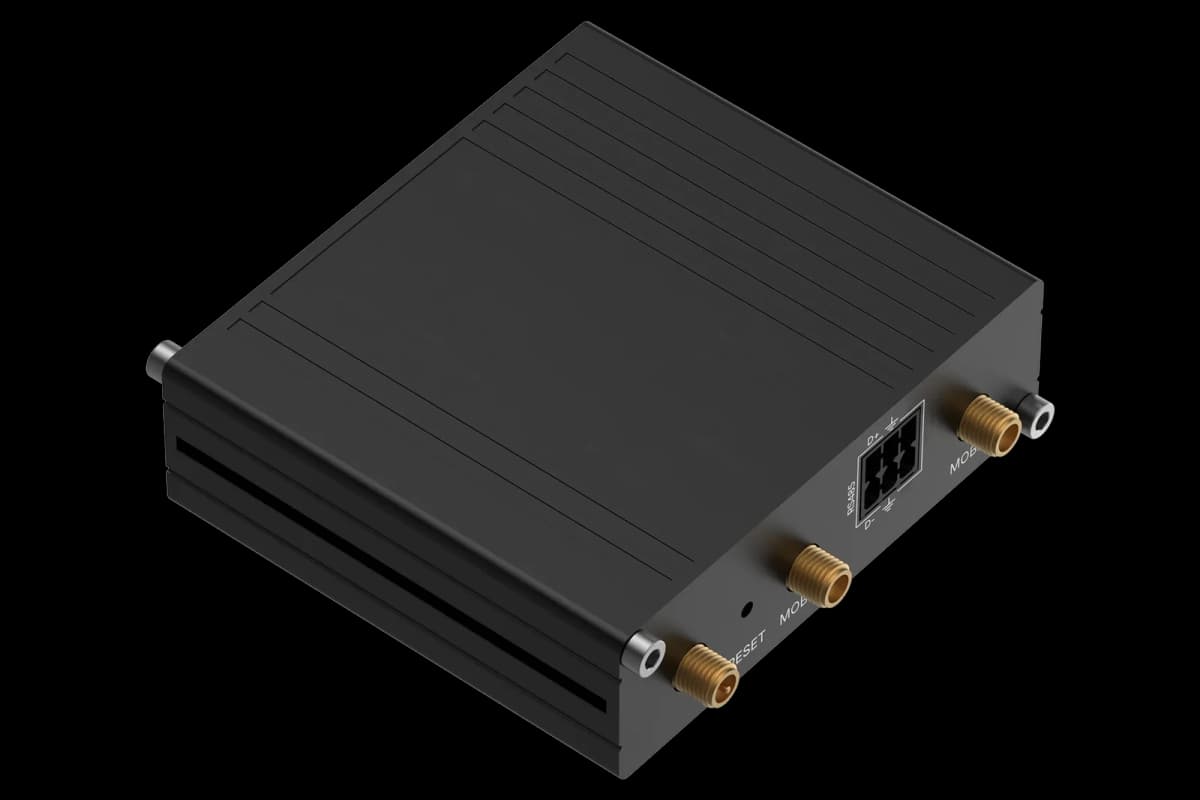
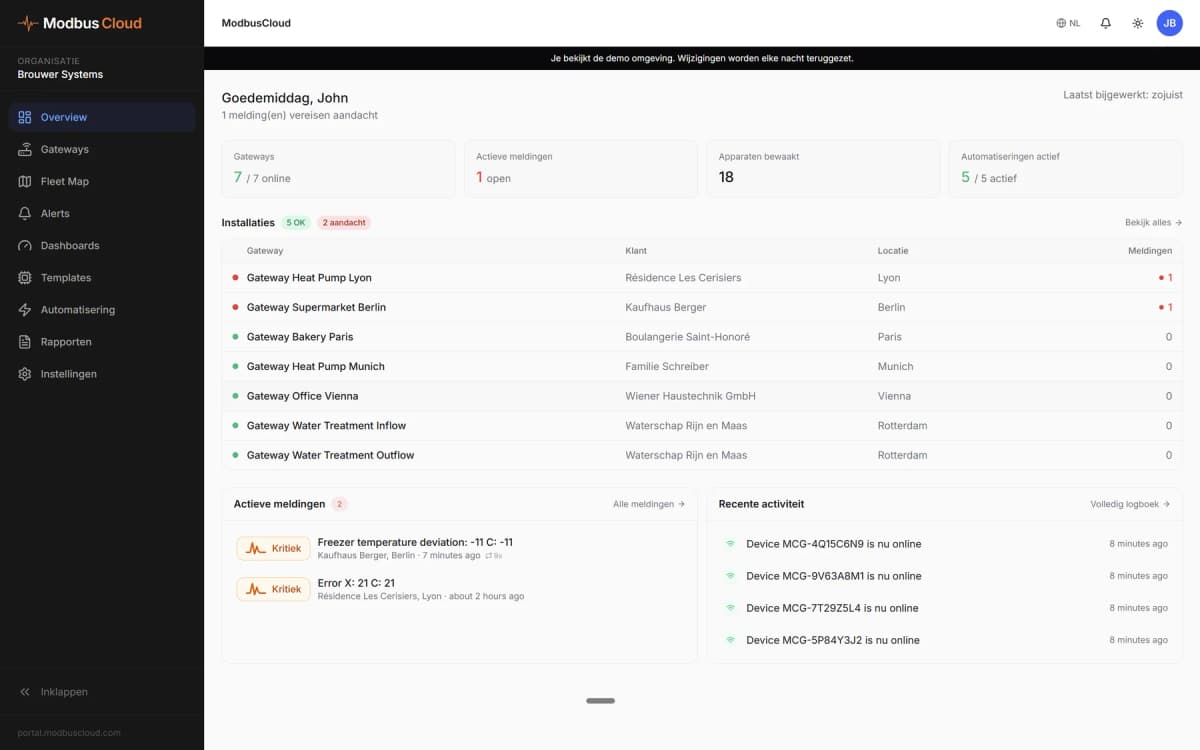
The ModbusCloud Gateway is a Teltonika-based 4G gateway, pre-configured for the ModbusCloud cloud. That saves commissioning time; you manage no separate VPN, no MQTT broker, no certificates. The Modbus gateway buyer guide goes deeper on the positioning of self-build versus pre-configured.
Three differences stand out. First: one portal licence per gateway, EUR 149 per year or EUR 495 once for lifetime, with every feature included and no tiers, which makes costs predictable. Second: EU-time support. Third: a deliberate Modbus focus, no BACnet or OPC UA, so no marketing around features you do not need. For projects where BACnet or OPC UA is required, we recommend IXON or Phoenix Contact; ModbusCloud is intentionally not an all-in-one platform.
Frequently asked questions
What is an industrial IoT gateway and when do I need one?
An industrial IoT gateway is a DIN-rail device that collects field-bus data (Modbus, BACnet, OPC UA) and forwards it encrypted via MQTT, HTTPS, or VPN to a cloud platform. You need one whenever OT data has to reach a central portal or monitoring service.
Which protocols should an industrial IoT gateway support?
For most installers: Modbus RTU over RS485, Modbus TCP over Ethernet, and MQTT with TLS to the cloud. Projects with a building management system add BACnet/IP; Siemens-heavy sites need S7. OPC UA is desirable for forward compatibility with Industry 4.0 stacks.
What is the difference between IoT and industrial IoT (IIoT)?
Consumer IoT focuses on convenience devices (smart lights, thermostats) using protocols like Zigbee or Z-Wave. Industrial IoT covers operational technology in plants, buildings, and infrastructure with industrial protocols (Modbus, BACnet, OPC UA, S7) and harsher environmental and security requirements.
Which IoT gateways already comply with NIS2 and the Cyber Resilience Act?
No gateway is officially CRA-certified in 2026 because the regulation only applies from 11 December 2027. Ask suppliers for their roadmap. NIS2 compliance depends mostly on your configuration (TLS, segmentation, patch management), not on the product alone.
How many Modbus devices can one IoT gateway handle?
An RS485 bus supports 247 slave addresses; in practice signal integrity drops around 32 devices. Modbus TCP has no hard limit, but polling time scales with device count. A Teltonika RUT956 polling 50 Modbus TCP devices at 1-second intervals runs fine.
Can I use a Raspberry Pi instead of an industrial IoT gateway?
For a proof of concept, yes. For a commercial installation, no. A Raspberry Pi lacks industrial temperature (0-50 C), galvanic isolation, IEC 60950 listing, and a CRA roadmap. Liability and lifespan (2-3 years versus 5-10 years) rule out consumer hardware in customer plants.
Conclusion
Picking an industrial IoT gateway in 2026 is not a price comparison but a trade-off between protocol coverage, connectivity, and cybersecurity. For fieldbus installers exposing Modbus RTU or TCP without a building management system, Teltonika or a pre-configured ModbusCloud Gateway is the fastest path; for integrators with BACnet, OPC UA, or S7 in scope, IXON or Phoenix Contact is the better fit. Above all: without a supplier CRA roadmap you are buying hardware with an expiry date.