

Modbus Protocol: History, Origin, and Why It Still Runs
The Modbus protocol explained: how Modicon created it in 1979, why it became open in 2004, and what that history means for you on the bus today.
The Modbus protocol is the common language an energy meter, heat pump, or inverter uses to hand over its values, and it is older than almost everything you connect it to. Modicon published it in 1979 for its own programmable controllers, and nearly half a century later you still speak it every working day. That is no accident. Once you understand where Modbus came from and why it stayed so simple, you immediately see why certain quirks bite you on the bus and others never do.
This guide explains the history of the Modbus protocol for installers, not for protocol historians. You will learn who created it, why it became open and royalty-free in 2004, how the 1979 design still works today, and what those choices mean for your daily work. For a broader explanation of the protocol itself, see our complete Modbus guide.
Key takeaways
- Modbus was created in 1979 by Modicon, the maker that also built the first PLC, and became an open, royalty-free standard under the Modbus Organization in 2004.
- The master-slave, request-response model has not changed in substance since 1979, and that simplicity is exactly what explains the huge installed base.
- The same simplicity means the standard fixes no meaning per register address, so every device still needs its own register map.
Free: RS485 and Modbus RTU installation checklist (PDF)
The pre-commissioning checklist for every RS485 bus.
- Wiring order: A/B polarity, GND and shielding
- Termination and biasing, with the multimeter checks
- Communication settings crib sheet (baud rate, parity, stop bits)
- The 10 most common faults and how to spot them
What is the Modbus protocol?
The Modbus protocol is an open communication protocol that lets a polling device (the master or client) exchange simple read and write messages with field devices (the slaves or servers) over a serial line or over Ethernet. It defines only what those messages look like and how they travel, not what the data means.
That is where the strength and the trap both live. Modbus fixes four data blocks and a handful of function codes, and nothing more. There is no device description, no automatic discovery, no built-in security. That plainness made it trivial to implement in 1979, which is why nearly every manufacturer adopted it. You feel the flip side today when you commission a new device and have to pull the meaning of each address out of the datasheet by hand.
Where Modbus came from: Modicon and 1979
To understand why Modbus is the way it is, you have to go back to the industry it grew out of: the programmable controller.
From the first PLC to the 1979 protocol
Modicon (a contraction of MOdular DIgital CONtroller) was founded in 1968 by a group of engineers around Dick Morley. That same team built the Modicon 084, widely recognized as the first programmable logic controller (PLC), for General Motors. According to the Modbus Organization, Modicon published the Modbus protocol in 1979 so its controllers could exchange data with peripheral equipment.
2004: the year Modbus became open
Schneider Electric acquired Modicon in 1997 and with it ownership of the protocol. The real turning point came in 2004: Schneider transferred the rights to Modbus to the Modbus Organization, an independent user group, and the specification became available free of charge and royalty-free. That same year the IEC accepted Modbus as a Publicly Available Specification. The fact that you can build or read a Modbus device today without paying a license fee is a direct result of that decision.
How the 1979 design still works
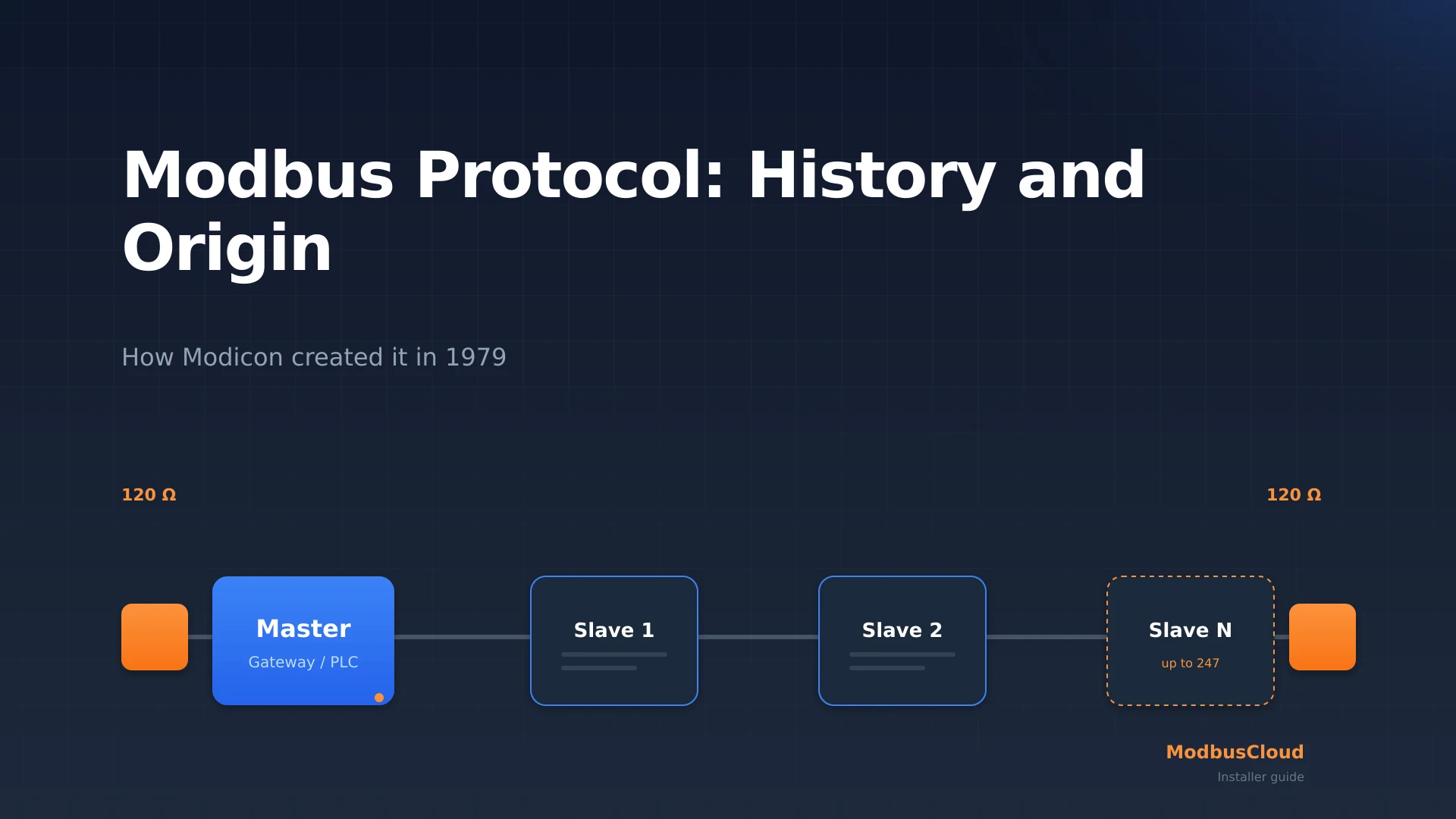
The communication model Modicon chose in 1979 has stayed remarkably simple. There is always a master that takes the initiative and slaves that only answer when addressed. The master sends a request with an address, a function code, and a register range; the addressed slave returns the requested values or reports an error. On a serial bus, up to 247 slaves can hold a unique address (1 to 247; 248 to 255 are reserved).
This explains a behavior that sometimes surprises installers. A slave never speaks on its own, so if you want a value you have to ask for it (poll it). Two devices sharing an address on a bus collide, because the master cannot tell who answered. And because all traffic runs through the single master, the poll rate decides how fresh your data is. The modern term is client-server rather than master-slave, but the mechanism is identical to 1979. To see which function code reads which register type, see our Modbus function codes reference.
Why the same address means different things per brand
The biggest design choice of 1979 was what Modbus deliberately does not settle. The standard fixes the transport and four data blocks, but never what a given address means. Register 40001 is a voltage on one meter, a setpoint on the next, and a firmware version on a third. There is no universal map and no gateway that automatically guesses what a register represents.
This is what surprises installers coming from BACnet, where objects carry self-describing names. With Modbus you always request the device's register map first. A second legacy of the plainness: the specification mandates big-endian for addresses and data fields, but does not fix the word order of a 32-bit value spread across two registers. Read them in the wrong order and you get a believable but wrong number. For the contrast between Modbus and the self-describing alternative, see BACnet versus Modbus.
From serial to Ethernet: RTU, ASCII, and TCP
Modbus began as a serial protocol over RS232 and later RS485, in two transmission modes: RTU (binary, compact, by far the most common) and ASCII (readable, but slower and heavier). When Ethernet reached the factory and the building, Modbus gained a TCP/IP variant in the late 1990s. Modbus TCP wraps the exact same message in a TCP packet and listens on port 502, a reserved port of its own in the internet world.
| Variant | Physical layer | Trait |
|---|---|---|
| Modbus RTU | RS485 / RS232 | Binary, compact, most common in the field |
| Modbus ASCII | RS485 / RS232 | Readable characters, slower, rare today |
| Modbus TCP | Ethernet / IP | Same message on port 502, no 247 address cap |
The core stayed the same message with the same function codes throughout; only the packaging changed. That is why you can put an RTU device and a TCP device into the same monitoring chain through a gateway. To choose the variant that fits a job, read Modbus RTU versus TCP, or the standalone explainers for Modbus RTU and Modbus TCP.
Why Modbus is still dominant
A protocol from 1979 that still runs raises the question of why nothing replaced it. The answer is a combination of three things: it has been open and royalty-free since 2004, it is dead simple to implement, and a vast installed base sits in the field. Modbus remains, alongside BACnet, one of the two most deployed protocols in HVAC, energy management, and building automation.
The numbers behind the installed base
The numbers confirm that this base is growing rather than shrinking. Within the Modbus world, the TCP variant now carries roughly 45 percent of installations and RTU about 35 percent, with TCP growing fastest on the back of the existing serial base. According to HMS Networks' 2025 industrial network survey, 76 percent of all new industrial network nodes are Ethernet-based, while serial RTU simply persists across the legacy base. For you as an installer, that means you will keep meeting Modbus on every job for the foreseeable future, old and new side by side.
What the history means for your installation
The practical lesson from forty-five years of Modbus is that the protocol deliberately does little for you. It transports plain numbers reliably, but meaning, address translation, and word order are yours to supply per device. That was a feature in 1979, because it kept the implementation small, and today it is the work that lands on your plate at every new installation.
That is exactly the work the ModbusCloud Gateway takes off your hands. The Gateway reads your Modbus RTU and TCP devices into a cloud dashboard through ready-made register templates, so you pick the device instead of decoding the map by hand. It handles the address translation and the word order for you, so the simplicity of 1979 works in your favor instead of against you.
Who created the Modbus protocol?
Modbus was created in 1979 by Modicon, the US maker that also built the first PLC in 1968. The protocol let Modicon controllers exchange data with peripheral equipment. Schneider Electric acquired Modicon in 1997 and transferred the rights to the Modbus Organization in 2004.
When was Modbus invented?
Modbus was published in 1979 by Modicon, making it one of the oldest industrial protocols still in use. In 2004 it became an open, royalty-free standard under the Modbus Organization and was accepted by the IEC as a Publicly Available Specification.
Is Modbus an open protocol?
Yes. Since 2004 the Modbus Organization has maintained the specification, which is free to download and royalty-free. You do not need a license to build or read a Modbus device. That openness is a major reason so many manufacturers support Modbus.
Why is Modbus still used?
Modbus is open, dead simple to implement, and backed by a vast installed base. Those three things together mean no newer protocol has displaced it. It remains, with BACnet, one of the most used protocols in HVAC, energy management, and building automation.
Who maintains the Modbus protocol today?
The Modbus Organization, an independent user group, has maintained the specification since Schneider Electric transferred the rights in 2004. It publishes the specifications free of charge and maintains the data model and function codes that every Modbus device is built on.
What is the difference between Modbus RTU and Modbus TCP?
Modbus RTU is the serial variant over RS485 or RS232 with a compact binary frame. Modbus TCP wraps the same message in a TCP packet on port 502 over Ethernet. The function codes and registers are identical; only the transport differs. A gateway bridges the two worlds.
Does Modbus have built-in security?
No. Modbus was designed in 1979 for a closed factory network, so there is no authentication or encryption in the protocol. Never put Modbus TCP directly on the internet. Always use a gateway or VPN that handles security and remote access on its behalf.
Ready to leave manual address translation behind? The ModbusCloud Gateway reads your Modbus devices into a cloud dashboard through ready-made templates and handles the legacy of 1979 automatically for you.
Question about your setup?
Ask it here. We think along with your project, and building a free integration is part of that.