

4G Modbus Gateway: Connectivity for Remote Sites (2026)
A 4G Modbus gateway sends RS485 data to the cloud over LTE. Which class to pick, how much SIM data you need, failover, and staying secure without a public IP.
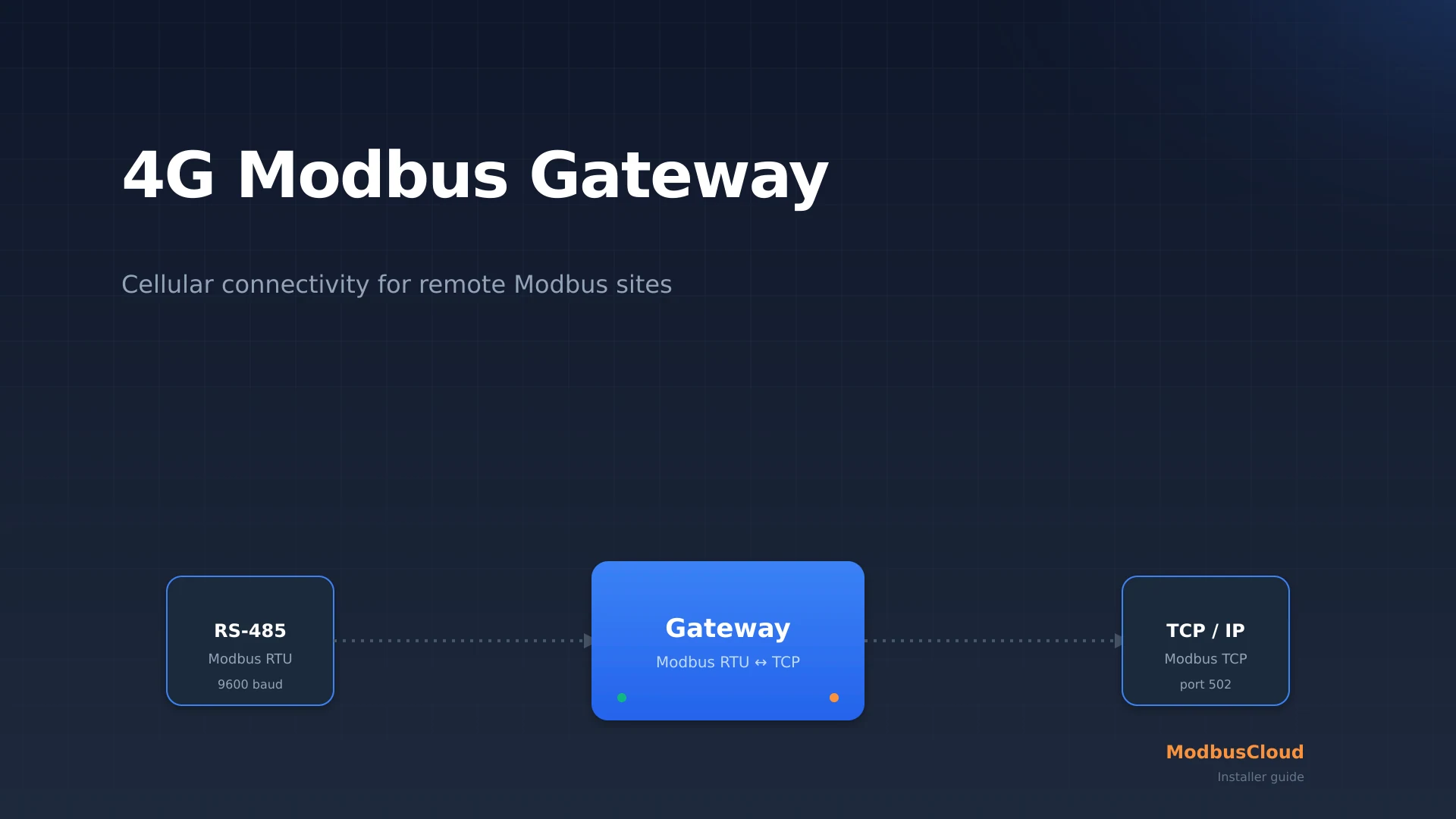
A 4G Modbus gateway gets an RS485 Modbus bus onto the internet at a site that has no wired connection: a solar park, a pumping station, a cold store, a remote plant room, or an EV charge point. Instead of an Ethernet cable, the gateway carries a SIM card and reaches the cloud over the mobile network. Most product pages sell you the box but skip the questions installers actually ask on site.
This guide answers those questions. You will learn what a 4G Modbus gateway does, when cellular is the right backhaul, which cellular class to specify (4G, LTE-M or NB-IoT), how much SIM data Modbus monitoring really uses per month, how failover keeps a remote site online, and how to get the data out securely without ever exposing a public IP. Written for installers, not for software developers.
Key takeaways
- A 4G Modbus gateway polls the RS485 bus as master and pushes the values outbound over LTE to a cloud broker, usually via MQTT, so no inbound port and no public IP are needed.
- The poll interval and the number of points set your cellular data bill, not the protocol: a 60 second interval on a small register count runs to tens of MB per month.
- With 2G and 3G being switched off across Europe, LTE Cat 4 is the durable baseline for new remote sites; keep LTE-M or NB-IoT for low-power sensor jobs.
What is a 4G Modbus gateway?
A 4G Modbus gateway is a device that reads Modbus RTU registers from an RS485 bus, then forwards those values to a cloud platform over a cellular (4G/LTE) connection instead of over Ethernet. On the field side it acts as the single Modbus master, polling each slave. On the network side it holds a SIM card and opens an outbound, encrypted session to the cloud. The application layer is unchanged: the same function codes, the same holding and input registers.
The reason it exists is simple. Almost every heat pump, energy meter, solar inverter, and refrigeration controller speaks only Modbus RTU over RS485, and a large share of the sites they sit in have no DSL or fibre. According to industrial connectivity vendors such as INSYS icom and Teltonika, remote solar and utility sites are the classic case: the equipment is there, but the fixed line is not. The gateway bridges that gap with a mobile uplink.
Because the gateway pushes data outbound, it works exactly like the wired case once the SIM is active. If you have not settled on RTU versus TCP first, read Modbus TCP explained. For choosing the box itself, the Modbus gateway buyer guide covers the wider decision.
When is cellular the right backhaul?
Cellular is the right choice whenever running a cable is impractical, temporary, or slower to arrange than the job allows. A wired line is cheaper per month and lower latency, so use it when it already exists. Reach for a 4G Modbus gateway in four situations that cover most remote-site work.
- No fixed line at all. Ground-mounted solar, pumping and lift stations, weather-exposed cabinets, and rural plant rooms often never had DSL.
- A line you do not control. In a tenant unit or a third-party building, the landlord's network is off limits, and IT will not add your device to it.
- Temporary or fast deployments. A retrofit or a pilot that must report data this week cannot wait for a fixed-line install.
- Physical separation from IT. Keeping the OT network fully off the corporate LAN is often easier with a dedicated SIM than with a VLAN request.
The regulatory backdrop pushes more of these sites toward monitoring. Since 1 January 2026, the EPBD recast (EU 2024/1275, article 14) lowered the threshold for mandatory building automation to 70 kW of heating or cooling output, so a growing group of mid-size and remote buildings must now feed continuous data to a higher system. Cellular is frequently the only backhaul available at those sites.
Which cellular class: 4G, LTE-M or NB-IoT?
The cellular class decides throughput, power draw, and how long the network will stay switched on. For a Modbus gateway that polls a bus and publishes to the cloud, LTE Cat 4 is the standard baseline, while the low-power classes suit small, battery-powered jobs.
| Class | Typical use | Throughput | Fit for a Modbus gateway |
|---|---|---|---|
| LTE Cat 4 | Mains-powered industrial routers | Up to 150/50 Mbps | Baseline. Ample headroom, cheap, widely stocked |
| LTE Cat 1 / Cat 1 bis | Lower-cost mains gateways | Up to ~10 Mbps | Fine for most single-site buses |
| LTE-M (Cat-M1) | Battery sensors, moving assets | Low | Small point counts, long poll intervals only |
| NB-IoT | Deep-indoor, static metering | Very low | Occasional reads, not live fleet polling |
Avoid designing a new site around 2G or 3G. In Germany all three operators switched off 3G (UMTS) in 2021, and 2G is scheduled to follow later this decade, with Telefónica Deutschland targeting the second half of 2028 (see the 2G/3G sunset tracker from Telenor IoT). A gateway commissioned on a retiring network is a service call waiting to happen. Specify LTE, and pick a module that can fall back to LTE-M or NB-IoT if the site is marginal on signal.
How much cellular data does Modbus monitoring use?
Less than most installers expect. Modbus telemetry over MQTT is small because the MQTT header is just 2 bytes, so the cloud publish adds almost no overhead on top of the register values themselves. As a worked estimate for around 20 register values sent as a compact message, each publish is on the order of 0.5 to 1 KB on the wire once TLS is amortised.
The pattern to remember: the poll interval and the point count set the bill, not the choice of protocol. A 60 second interval on a small bus lands well inside a 500 MB or 1 GB M2M data plan. Drop to a 5 second interval and the volume multiplies roughly twelvefold. This is why industrial vendors such as Robustel stress edge filtering: publish on change or on a sensible cadence rather than streaming every reading. If you need faster local sampling with a slower cloud push, set the cloud interval independently and let the gateway buffer.
Free: RS485 and Modbus RTU installation checklist (PDF)
The pre-commissioning checklist for every RS485 bus. Print it and take it to site.
- Wiring order: A/B polarity, GND and shielding
- Termination and biasing, with the multimeter checks
- Communication settings crib sheet (baud rate, parity, stop bits)
- The 10 most common faults and how to spot them
We send you the checklist plus an occasional practical Modbus tip. No spam, unsubscribe anytime.
Building resilience: dual SIM and failover
A remote site is only as reliable as its uplink, so specify redundancy where downtime costs money. Industrial cellular gateways offer three layers, and you can stack them.
Dual SIM for carrier redundancy
Dual SIM lets the gateway hold two carriers and switch automatically when one drops or loses coverage. No single network reaches every rural corner, and a second carrier on a different frequency band often holds where the first fades. Keep the two SIMs on different operators, not two SIMs from one reseller that ride the same radio network.
WAN failover between wired and cellular
WAN failover lets a gateway prefer a wired line when one is present and fall back to cellular when it fails, or the reverse. On a site with intermittent DSL, cellular becomes the safety net; on a pure cellular site, a second SIM plays the same role. Set the failover timeout tight enough to catch a dropout but loose enough to ignore a brief signal dip.
Roaming and multi-network SIMs
Roaming or multi-network M2M SIMs attach to whichever of several networks is strongest at each location, which suits a fleet spread across regions with uneven coverage. Platforms such as Teltonika's RutOS expose all three layers, along with automatic failover between the SIM slots.
How do you keep a cellular gateway secure without a public IP?
You keep it secure by never accepting an inbound connection. Modbus has no authentication and no encryption, so anyone who can reach the device can read and write registers, as the MODBUS Application Protocol specification from the Modbus Organization makes clear. The safe pattern on cellular is identical to the wired one: the gateway opens a single outbound, encrypted (TLS or VPN) session to the cloud, and nothing listens for incoming traffic.
A public or static IP on the SIM is a convenience for direct remote access, but it is also a permanent attack surface that public scanners find within seconds. Prefer an outbound-only design, or a managed VPN and remote-management service, so the gateway stays reachable to you without being reachable to the internet at large.
One dashboard for many remote sites
The payoff of cellular monitoring shows up across a fleet. When every remote site runs one gateway that reports into the same platform, a fault on any single site surfaces in one shared alert feed instead of a per-site portal you have to check by hand.
To set the alerting up, see Modbus alerts: a complete setup guide. For the broader remote-access options and how a cloud platform compares with a VPN, read the remote Modbus monitoring buyer guide. If you are still choosing hardware, the industrial IoT gateway comparison lines up ten options, and remote solar sites specifically are covered in solar inverter Modbus monitoring.
Troubleshooting a 4G Modbus gateway
Most faults sit on the RS485 side or with the SIM, not with Modbus itself. The table lists the five you will meet most.
| Symptom | Probable cause | Fix |
|---|---|---|
| No cloud connection at all | SIM not activated or wrong APN | Activate the SIM, set the carrier APN, check the data plan is live |
| Connects, then drops repeatedly | Weak signal (low RSRP) | Move the antenna outside the cabinet, add an external or directional antenna |
| Cloud is fine, no register data | RS485 wiring or wrong baud rate | Check A/B polarity and GND, match baud rate and parity to the slaves |
| Data plan exhausted early | Poll interval too fast | Increase the cloud publish interval, publish on change, filter at the edge |
| Works on 2G, fails intermittently | Legacy network being retired | Force LTE, replace any 2G/3G-only module |
For the RS485 side in depth, the RS485 wiring guide covers polarity, termination, and cable length.
FAQ
What is a 4G Modbus gateway?
A 4G Modbus gateway reads Modbus RTU registers from an RS485 bus and forwards the values to a cloud platform over the mobile network instead of Ethernet. It polls the bus as master and holds a SIM card, so it works at sites with no wired internet.
How does a cellular Modbus gateway work without a static IP?
The gateway opens an outbound, encrypted connection to the cloud, usually over MQTT. Because it initiates the session, no inbound port and no public IP are required. This is safer than a static IP, which public scanners find within seconds.
How much cellular data does Modbus monitoring use per month?
For roughly 20 registers published over MQTT at a 60 second interval, expect tens of MB per month, well inside a 500 MB or 1 GB M2M plan. A 5 second interval multiplies that about twelvefold. The poll interval and point count set the bill.
Do I need 4G or is LTE-M or NB-IoT enough for Modbus?
LTE Cat 4 is the safe baseline for a mains-powered gateway that polls a bus. LTE-M and NB-IoT are low-power classes for battery sensors with few points and long intervals. Use them for occasional reads, not for live fleet polling.
Can I still use 2G or 3G for a Modbus gateway in 2026?
Avoid it for new sites. All three German operators switched off 3G in 2021, and 2G is scheduled to end later this decade. Commission new remote Modbus sites on LTE so the uplink survives the network sunset.
Can a 4G Modbus gateway fail over to a second SIM or Ethernet?
Yes. Industrial gateways support dual-SIM automatic failover between two carriers and WAN failover between a wired line and cellular. Roaming M2M SIMs also attach to whichever network is strongest at the site, which improves rural reliability.
Is a cellular Modbus gateway secure?
It is secure when it only makes outbound, encrypted connections. Never expose Modbus port 502 on a public cellular IP. Use TLS or a VPN and keep the Modbus side inside that tunnel, treating the cellular link as untrusted transport per IEC 62443.
Once a remote site is reporting, the next step is usually a central dashboard for the whole fleet. A ModbusCloud Gateway reads the Modbus bus over RS485 and sends every data point securely over 4G or Ethernet, without opening a single inbound port.
Ready to get started?
Order the ModbusCloud Gateway and start monitoring your installations within 5 minutes.
View the gateway