On this page
Submetering means installing meters downstream of the utility meter, so one bill can be split across tenants, floors or loads. You read the submeters remotely through their communication port, on most commercial electric meters Modbus RTU over an RS485 bus. A gateway polls the energy registers and sends them to a portal or your own billing system. For tenant billing you read the import energy register of a revenue grade meter, not the power value.
Remote reading replaces the monthly walk past every panel with consumption data that building owners and facility managers can bill from and act on.
The sections below are for the electrical contractor or facility engineer who installs submeters in multi tenant office buildings and industrial facilities, or reads existing ones.
A submeter measures one part of the installation behind the utility meter
A submeter sits in the building's own installation, downstream of the utility meter, and measures one tenant space, a floor, a panel or a single piece of equipment. The utility company still bills the entire building from a single meter. The submetering system divides that energy consumption across individual tenant spaces, so cost allocation follows actual usage instead of floor area.
The US General Services Administration (GSA) describes five levels of metering: whole building, system level, panel or circuit, end-use device and embedded device. Most tenant billing happens at panel level. Energy management often goes deeper, to HVAC systems, outdoor lighting, plug loads or one chiller on its own electrical circuits.
Submeters exist for electricity, natural gas, water and thermal energy. This article covers electric submeters in a distribution board. Water meters and heat meters often use M-Bus instead of Modbus, which the article on M-Bus and how it differs from Modbus explains.
A submeter without a communication port shows its reading on a display, and nothing more. Remote meter reading needs a meter with a Modbus, M-Bus or pulse output.
Revenue grade: the accuracy class and the marking on the meter
A revenue grade meter is one whose accuracy class is good enough to bill from. In North America that class comes from ANSI C12.20, which defines accuracy classes 0.5 and 0.2, and since the 2015 edition also 0.1. Class 0.5 allows an error of ±0.5% at unity power factor.
In the EU the reference is the Measuring Instruments Directive 2014/32/EU (MID). Annex V covers active electrical energy meters "for residential, commercial and light industrial use" in accuracy classes A, B and C, where C allows the smallest errors. A MID meter carries the CE marking, followed directly by a rectangle with the letter M and the last two digits of the year (Articles 21 and 22). The number of the notified body comes after it. "M26" on the data plate means the marking was applied in 2026.
Some countries add periodic re-verification. Germany, for example, gives electronic electricity meters a verification period of 8 years and heat and water meters 6 years (MessEV, Annex 7). For energy management without billing, a meter without these approvals is enough.
Three ways to read a submeter remotely
A submeter hands over its values through Modbus, M-Bus or a pulse output. The table shows what each route delivers.
| Route | What the meter delivers | Where you find it |
|---|---|---|
| Modbus RTU over RS485 | Energy registers, power, voltage and current per phase | Commercial DIN rail electric meters |
| Modbus TCP | The same registers over Ethernet | Power analysers, TCP versions of energy meters |
| M-Bus | Meter readings with the unit in every record | Heat, water and gas meters |
| Pulse output | One pulse per fixed quantity of energy | Older and low-cost meters |
Only Modbus and M-Bus carry the meter reading itself. The comparison of Modbus energy meters lists which models have a Modbus port. A pulse counter starts at zero when counting starts. Every missed pulse makes its total drift further from the display, and nothing corrects it later.
Which registers to read for tenant billing
For tenant billing you read the import energy register, because it counts only what the circuit draws from the grid. On an Eastron SDM630 that is input register 30073, Total Import kWh, read with function code 04 (Eastron, SDM630 Modbus Protocol Implementation V1.8).
Register 30343 is labelled "Total kWh". Note 3 in the same document says it equals import plus export. If solar panels feed in behind the submeter, the exported energy is counted as consumption. The error shows up only when a tenant checks the bill.
Each SDM630 value is a 32-bit float in two registers, most significant register first by default. Always request an even number of registers, because an odd number returns an exception. One request reads at most 80 registers. Other manufacturers number their registers differently, so check the register table for every meter model. The article on reading a Modbus register map shows how.
Wiring several submeters on one RS485 bus
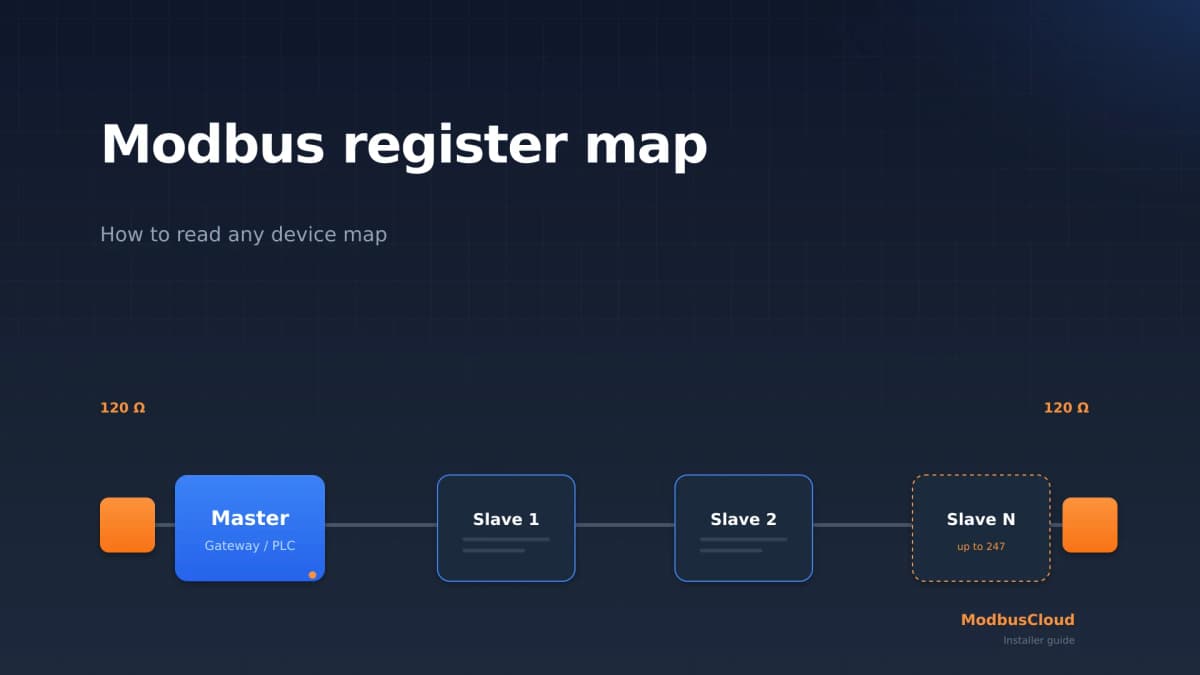
One RS485 bus takes at most 32 electrical nodes, the gateway included. Eastron's SDM630 manual gives a total bus length of at most 1200 metres and shielded twisted pair cable such as Belden 8761.
Daisy chain A and B from meter to meter, without stubs. Fit a 120 Ω termination resistor (0.25 W minimum) at both ends of the line. Give every meter its own Modbus address between 1 and 247. From the factory the SDM630 is set to address 1, 9600 baud, no parity and one stop bit. With five meters on the bus, you change four addresses before the first poll.
Installing meters in a live panel is work for a qualified electrician with the supply isolated. Shielding, grounding and cable routing are covered in the RS485 wiring guide.
From meter readings to a tenant bill
A tenant's consumption for a month is the difference between two readings of the import register. You read it on the first day of the month and on the first day of the next month, and subtract.
The counter inside the meter keeps running when the link to the gateway drops for an hour. The consumption of that hour is in the next reading. Power in watts is a snapshot, and you cannot build an invoice from snapshots without gaps.
Power values and short intervals serve energy monitoring: which circuit draws what, and when, and where energy usage patterns differ from last week. The SDM630, for example, also reports power quality values such as THD and power factor per phase. The GSA puts the limit plainly: the meter "does not save energy but can drive action based on review of the data". Savings come from what you change after you see where the energy goes.
Codes and rules that ask for submetering
Several energy codes require submetering in larger buildings. Three examples show the range.
ASHRAE Standard 90.1, section 8.4.3, asks for electrical energy monitoring in buildings of 25 000 ft² or more. It covers the total, HVAC, interior and exterior lighting, receptacle circuits and refrigeration, separately for each tenant. Data is recorded at least every 15 minutes, reported hourly, daily, monthly and annually, and kept for at least 36 months. Tenant spaces under 10 000 ft² are exempt. Which edition applies depends on the code your jurisdiction adopted.
New York City's Local Law 88 of 2009 required owners to install submeters in covered non-residential tenant spaces of 10 000 gross ft² or more by 1 January 2025. It applies to buildings over 50 000 gross ft², and owners must give those tenants monthly statements of their electricity use.
In the EU, Article 9c of the Energy Efficiency Directive 2012/27/EU covers heating, cooling and domestic hot water. Meters and heat cost allocators installed after 25 October 2020 must be remotely readable. Existing ones must be made remotely readable or replaced by 1 January 2027, unless the member state shows that this is not cost-efficient. The rule does not apply to electric submeters.
Limits of submetering
Submetering costs money per point: a meter, CTs above the meter's direct current rating, cabling, a gateway, and an electrician's time. Property owners weigh that against utility costs they can then bill accurately. A building with two tenants on separate utility meters gains little.
Resale of electricity to tenants is regulated, and the rules differ by state and by country. Some jurisdictions require meters approved by a regulator, or tenant consent, before you bill from a submeter. Check the local rules before the first invoice. This article lists none of them, because we did not read them all.
A meter reads only what passes through it. A wrongly assigned circuit, a missing CT or a wrong CT ratio produces a wrong bill with a precise number on it.
What is an electrical submeter?
A meter installed downstream of the utility meter that measures the electricity use of one tenant space, floor, panel or piece of equipment. The utility still bills the building from its own meter. The submeter divides that consumption inside the building, for tenant billing or for energy management.
How does an electrical submeter work?
It measures voltage and current on each phase, directly or through current transformers, and adds up the energy in an internal counter. Meters with a Modbus or M-Bus port make that counter and the live values available, so a gateway can read them remotely and pass them on.
Can I read my electric meter remotely?
Yes, if the submeter has a communication port. Most commercial meters offer Modbus RTU over RS485, some Modbus TCP or M-Bus. A gateway on the bus polls the energy registers. A meter with only a display needs a person to read it, and a pulse output gives a count rather than the reading itself.
Which register should I bill tenants from?
The import energy register in kWh. On the Eastron SDM630 that is input register 30073. Register 30343 adds import and export, so with solar export behind the meter it reads too high. Other brands use other addresses, so check the manufacturer's register table for each model.
How many submeters can share one RS485 bus?
At most 32 electrical nodes, including the gateway, according to Eastron's SDM630 manual. Each meter needs its own Modbus address between 1 and 247, and a 120 Ω termination resistor sits at both ends of the line. Longer runs and more meters need a second bus.
What are the disadvantages of submetering?
Cost per metering point, regulation of electricity resale that differs by state and country, and the risk of a wrong bill from a wrongly assigned circuit or CT ratio. In a building with few tenants on separate utility meters, the cost often outweighs what the data adds.
The ModbusCloud Gateway reads up to 32 Modbus devices per RS485 line, plus meters with Modbus TCP on the network. The template library includes the Eastron SDM630, the Janitza UMG series and Schneider energy meters. By default the Gateway reads every 5 minutes, and the history keeps 365 days. That is less than the 36 months ASHRAE 90.1 asks for. For that requirement you download the CSV per gateway, or pull the readings through the REST API into your own archive. If the connection drops, the Gateway buffers the readings and sends them once it is back. The Gateway costs EUR 295, the portal licence EUR 149 per year or EUR 495 one-off.