

Apogee Instruments SP-522
Heated thermopile pyranometer that measures global shortwave radiation outdoors in W/m².
The Apogee Instruments SP-522 is a heated thermopile pyranometer that measures global shortwave radiation outdoors, on weather stations, greenhouse sites and solar arrays. This Modbus RTU template reads radiation in W/m², the detector signal, heater and device status and identification, and lets you set the Modbus address and serial settings from ModbusCloud.
- Protocol
- Modbus RTU
- Connection
- RS485, 19200 baud
- Registers
- 28, read and write
- Brand
- Apogee Instruments
- Key readings
- Global shortwave radiation · Detector signal · Heater status · Device status · Firmware version · Serial number
- Available commands
- Modbus address · Baud rate · Parity · Stop bits
- Compatible models
- SP-522 · SP-522-SS
- Last updated
Registers (28)
28 read, 20 write
| Name | Unit | Access | Address (Hidden until you enter your email) | Function (hidden) | Type (hidden) |
|---|---|---|---|---|---|
| Calibrated Output Shortwave Radiation | W/m² | Read | |||
| Detector Millivolts | mV | Read | |||
| Device Status | Read | ||||
| Firmware Version | Read | ||||
| Calibrated Output Shortwave Radiation (Integer) | W/m² | Read | |||
| Detector Millivolts (Integer) | mV | Read | |||
| Device Status (Integer) | Read | ||||
| Firmware Version (Integer) | Read | ||||
| Heater Status | Read and write | ||||
| Slave Address | Read and write | ||||
| Baud Rate | Read and write | ||||
| Parity | Read and write | ||||
| Stop Bits | Read and write | ||||
| Running Average | Read and write | ||||
| Model Number | Read and write | ||||
| Serial Number | Read and write | ||||
| Multiplier | Read and write | ||||
| Offset | Read and write | ||||
| Heater Status (Integer) | Read and write | ||||
| Slave Address (Integer) | Read and write | ||||
| Baud Rate (Integer) | Read and write | ||||
| Parity (Integer) | Read and write | ||||
| Stop Bits (Integer) | Read and write | ||||
| Running Average (Integer) | Read and write | ||||
| Model Number (Integer) | Read and write | ||||
| Serial Number (Integer) | Read and write | ||||
| Multiplier (Integer) | Read and write | ||||
| Offset (Integer) | Read and write |
Loading registers…
Send your device list
If a device is not in the library yet, we build the template for free as soon as we have the register data.
Use cases
- Show outside radiation next to greenhouse climate values on one dashboard and keep 365 days of history.
- Download the radiation history as CSV to work out the daily radiation sum for irrigation or crop records.
- Use an automation on radiation to send a webhook to your climate or screen control when it passes a set level.
- Put radiation next to the yield of a PV system on one dashboard to check whether the array performs as expected.
- Get an email alert when the pyranometer stops sending values, or let automatic monitoring flag a frozen reading.
Installation
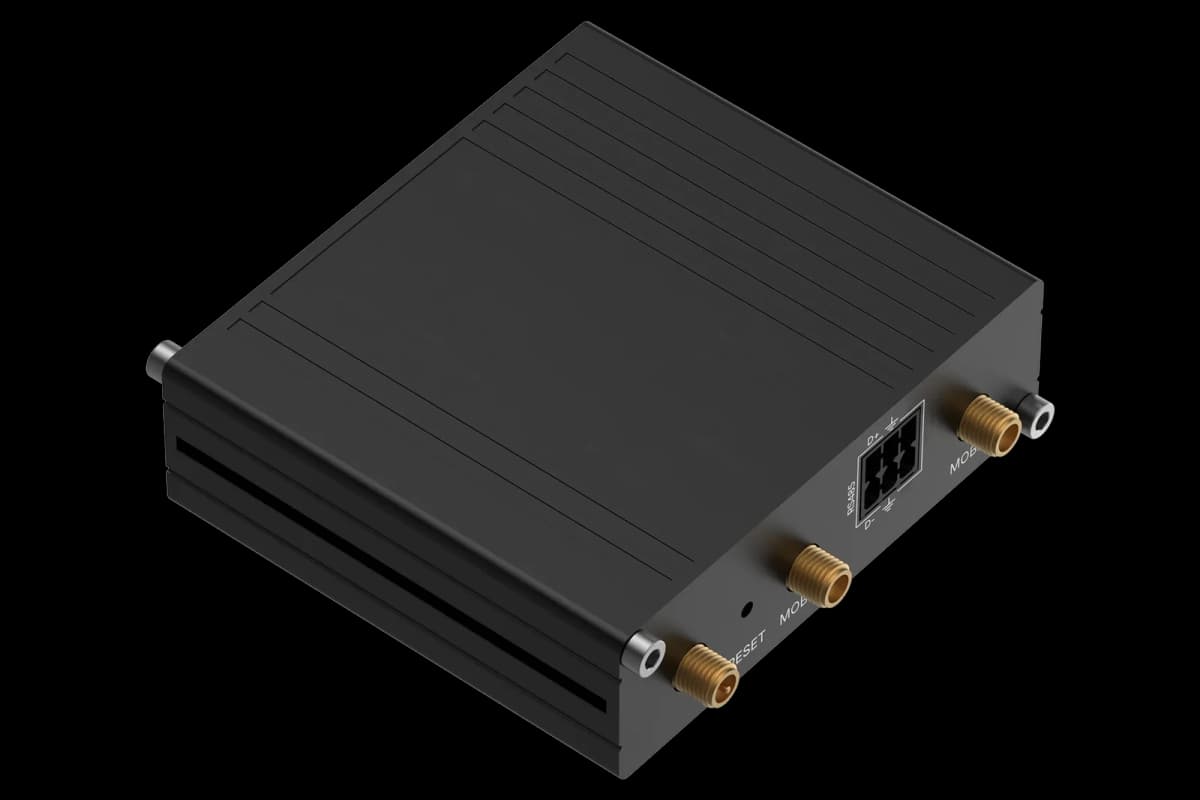
Connect the green wire to ground to select RS-485. Wire white to RS-485 positive and blue to RS-485 negative on the ModbusCloud Gateway, and connect the shield to earth.
Power the sensor with 5.5 to 24 V: red to plus, black to ground. Mount it level, free of shade, with the cable pointing north in the northern hemisphere.
For more sensors on one bus, connect them one at a time and give each a unique address with Slave Address; every sensor ships with address 1.
In ModbusCloud, add a Modbus device with protocol RTU, address 1, 19200 baud, 8 data bits, even parity and 1 stop bit, and import this template.
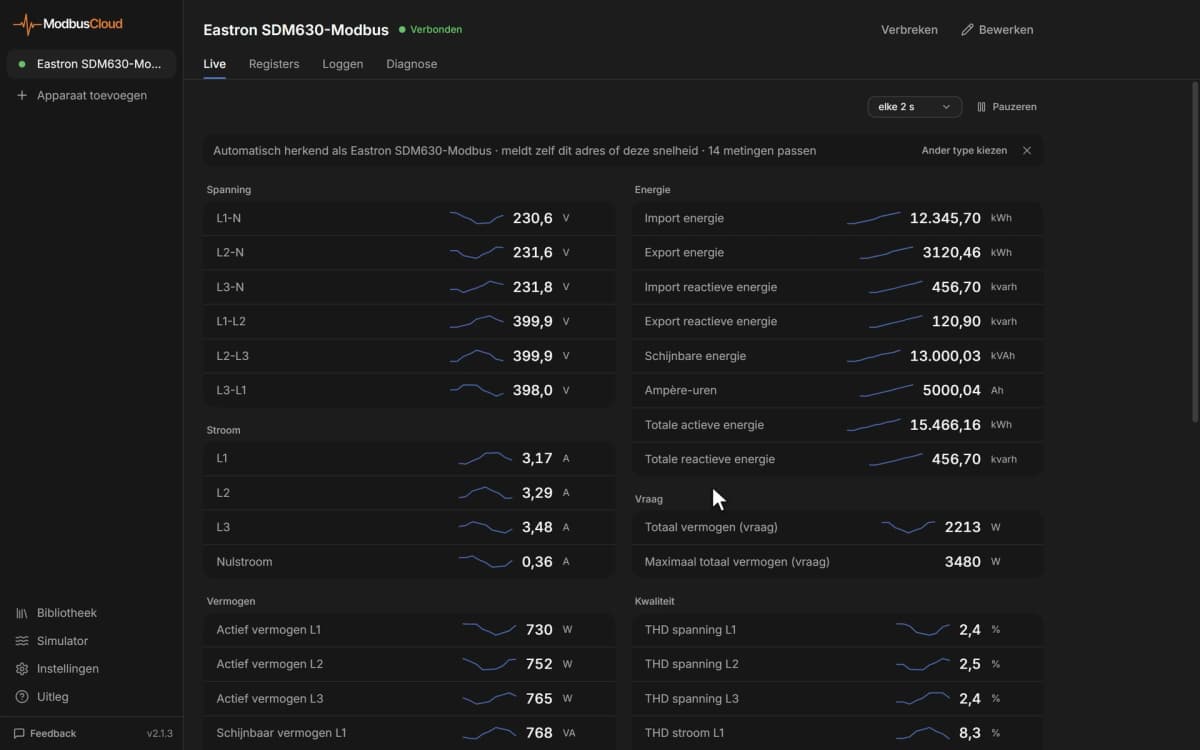
Check that Calibrated Output Shortwave Radiation follows the daylight and stays close to zero at night.
Things to watch for
The pyranometer does not answer. What should I check?
Check that the green wire is connected to ground; on 12 V the sensor talks RS-232 instead of RS-485. Then check 19200 baud, even parity, 1 stop bit and address 1 in ModbusCloud, and swap the white and blue wires if nothing comes back. Check the supply too: 5.5 to 24 V on red and black.
Why does radiation show a few W/m² at night?
A small zero offset is normal for a thermopile pyranometer. The SP-522 is specified at less than 5 W/m², or less than 10 W/m² with the heater on. Values far above that at night point to a wiring or sensor fault.
Why does every reading appear twice?
Each value is available as a precise floating point register and as an integer copy with a fixed decimal shift. Use the float registers for dashboards and alerts; the integer copy is there for systems that cannot read floats.
How do I put several sensors on one bus?
Every SP-522 ships with address 1. Connect one sensor at a time, write a new address from 1 to 247 to Slave Address, and change the address of that Modbus device in ModbusCloud. Never write 0: the sensor then returns to address 1 and also resets its factory calibration values.
Can I switch the heater or write calibration values?
Writing is off per gateway by default; request it for the gateway in the portal. Read Heater Status first and ask Apogee Instruments which values the sensor accepts before you write it. Multiplier, Offset, Model Number and Serial Number only accept writes after a procedure from Apogee. Change Baud Rate, Parity or Stop Bits only together with ModbusCloud.


Want to see how it works?