








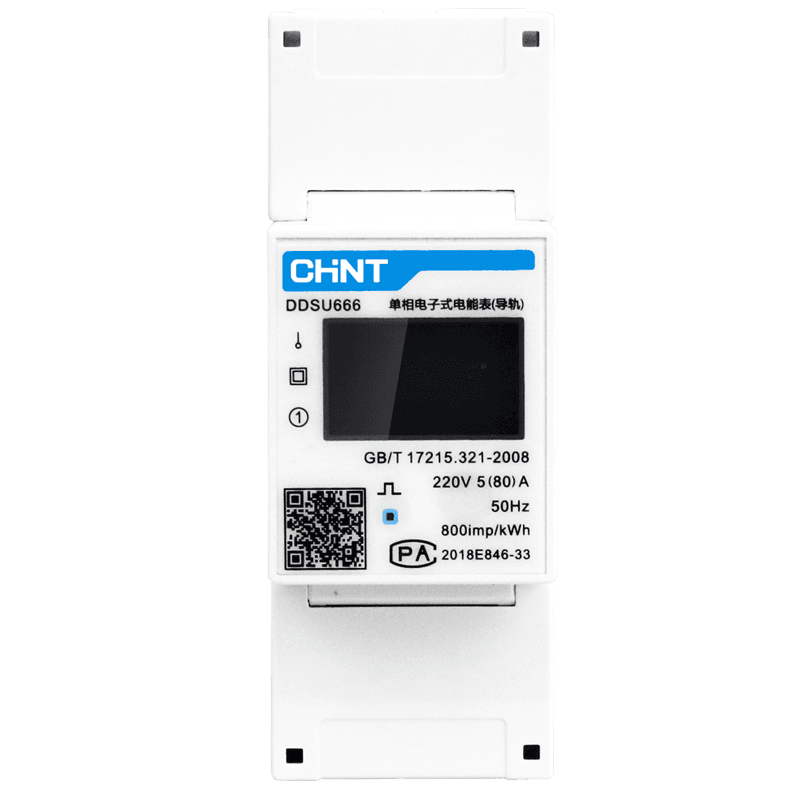
Chint DDSU666 Energy Meter 1-phase
Monitors single-phase electrical parameters and energy consumption via Modbus RTU.
The Chint DDSU666 is a single-phase DIN-rail energy meter that measures voltage, current, power, frequency, power factor, and accumulated energy. This Modbus RTU template reads all key electrical parameters over RS485, enabling remote monitoring without any on-site display interaction.
- Protocol
- Modbus RTU
- Connection
- RS485, 9600 baud
- Registers
- 8, read only
- Brand
- Chint
- Key readings
- Voltage · Current · Frequency · Instant Total Active Power · Instant Total Reactive Power · Instant Total Apparent Power
- Compatible models
- DDSU666
- Last updated
Registers (8)
8 read, 0 write
| Name | Unit | Access | Address (Hidden until you enter your email) | Function (hidden) | Type (hidden) |
|---|---|---|---|---|---|
| Voltage | V | Read | |||
| Frequency | Hz | Read | |||
| Current | A | Read | |||
| Instant Total Active Power | W | Read | |||
| Instant Total Reactive Power | var | Read | |||
| Total Power Factor | Read | ||||
| Instant Total Apparent Power | var | Read | |||
| Positive Active Total Energy | kWh | Read |
Loading registers…
Send your device list
If a device is not in the library yet, we build the template for free as soon as we have the register data.
Use cases
- Monitor real-time voltage, current, and power consumption of a single-phase circuit from the cloud dashboard.
- Track accumulated energy consumption in kWh for tenant billing or sub-metering purposes.
- Create an alert when power factor drops below a defined threshold to detect potential reactive power issues.
- Log frequency readings over time to identify grid quality deviations at a customer site.
- Generate weekly or monthly energy reports for energy audits or sustainability documentation.
- Compare instant active, reactive, and apparent power to assess load characteristics remotely.
Installation
Wire the RS485 A and B terminals of the Chint DDSU666 to the corresponding RS485 terminals on your ModbusCloud Gateway, observing correct polarity.
Set the Modbus slave address on the DDSU666 using the meter's front panel buttons, and ensure it does not conflict with other devices on the same bus.
Confirm the meter's communication settings are 9600 baud, odd parity (default), matching the template configuration.
Log in to the ModbusCloud platform, navigate to the template library, and import the Chint DDSU666 template to your project.
Assign the configured slave address in the ModbusCloud template and verify that live readings for voltage, current, and power appear on the dashboard.
If using a long RS485 cable run or multiple devices on the bus, add a 120 ohm termination resistor at the last device on the bus.
Things to watch for
I see zero or incorrect values for voltage and power. What could be wrong?
The DDSU666 uses float32 (IEEE 754) encoding across two consecutive registers. Verify that the byte order and word order settings in your gateway match the meter's format. The template is preconfigured for this, but manual overrides may cause misreads.
The gateway cannot communicate with the meter at all. What should I check?
Confirm that the RS485 A and B wires are not swapped. Also verify the baud rate is set to 9600 and parity is set to odd (1 stop bit) on both the meter and the gateway. Check that the slave address on the meter matches the address configured in the template.
Can I connect multiple DDSU666 meters to one ModbusCloud gateway?
Yes. Assign a unique Modbus slave address to each meter and daisy-chain them on the RS485 bus. Import a separate template instance for each meter and set the corresponding slave address in ModbusCloud.
Does the energy reading reset when the meter loses power?
No. The DDSU666 stores the accumulated energy total in non-volatile memory. The kWh value persists through power cycles and continues counting when power is restored.
More Chint templates
Want to see how it works?
