








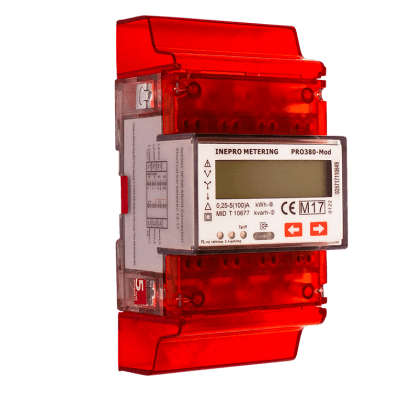
Inepro PRO380 Mod energy meter
Monitors three-phase energy metering via Modbus RTU
The Inepro PRO380-Mod is a three-phase energy meter with Modbus RTU connectivity. This template reads voltage, current, active power, apparent power, frequency, and energy totals per tariff, and allows tariff selection.
- Protocol
- Modbus RTU
- Connection
- RS485, 9600 baud
- Registers
- 15, read and write
- Brand
- Inepro
- Key readings
- Voltage L1 to L3 · Current L1 to L3 · Total active power · Total apparent power · Grid frequency · T1/T2 active and reverse energy
- Available commands
- Tariff
- Compatible models
- Inepro PRO380-Mod
- Last updated
Registers (15)
15 read, 1 write
| Name | Unit | Access | Address (Hidden until you enter your email) | Function (hidden) | Type (hidden) |
|---|---|---|---|---|---|
| Grid frequency [Hz] | Hz | Read | |||
| T1 reverse active energy [kWh] | kWh | Read | |||
| L1 Voltage [V] | V | Read | |||
| L1 Current [A] | A | Read | |||
| Power Down Counter | Read | ||||
| Modbus ID | Read | ||||
| L2 Voltage [V] | V | Read | |||
| L3 Voltage [V] | V | Read | |||
| L2 Current [A] | A | Read | |||
| L3 Current [A] | A | Read | |||
| Total active power [kW] | kW | Read | |||
| Total apparent power [kVA] | kVA | Read | |||
| T2 reverse active energy [kWh] | kWh | Read | |||
| Tariff | Read and write | ||||
| T1 Total active energy [kWh] | kWh | Read |
Loading registers…
Send your device list
If a device is not in the library yet, we build the template for free as soon as we have the register data.
Use cases
- Monitor per-phase voltage and current on a live dashboard to detect load imbalance across three phases.
- Track T1 and T2 energy consumption over time to compare tariff period usage for billing verification.
- Create an alert when total active power exceeds a predefined threshold to prevent demand charges.
- Log reverse energy totals to verify solar self-consumption and grid feed-in at a customer site.
- Switch the active tariff register remotely to align meter readings with the utility tariff schedule.
Installation
Mount the Inepro PRO380-Mod on a DIN rail inside the electrical panel and wire the current and voltage inputs according to the manufacturer wiring diagram.
Connect the RS-485 A and B terminals of the PRO380-Mod to the corresponding terminals on the ModbusCloud Gateway, using a twisted-pair cable with optional shielding.
Set the Modbus slave address on the PRO380-Mod using its front panel buttons, ensuring it does not conflict with other devices on the same RS-485 bus.
Configure the ModbusCloud gateway serial port to 9600 baud, even parity, and 1 stop bit to match the meter defaults.
Import the Inepro PRO380-Mod template in the ModbusCloud portal and assign the correct slave address to start reading data.
Verify live readings in the ModbusCloud dashboard by comparing displayed voltage and current values against a reference measurement at the panel.
Things to watch for
Why am I getting no response from the PRO380-Mod on the Modbus bus?
Check that the baud rate is set to 9600 and parity is set to even (1 stop bit) on both the gateway and the meter. Also verify the RS-485 A and B wiring is not swapped.
The register values look incorrect or show very large numbers. What could be wrong?
The PRO380-Mod uses float32 encoding for most measurement registers. Make sure the gateway is configured to read two consecutive 16-bit registers per value and that the byte order matches (big-endian word order). The template handles this by default.
Can I connect multiple PRO380-Mod meters to one gateway?
Yes. Assign a unique Modbus slave address to each meter and daisy-chain them on the RS-485 bus. Add a separate device instance in ModbusCloud for each address using the same template.
Register addresses in the Inepro documentation are in hexadecimal. Do I need to convert them?
No. The ModbusCloud template already uses the correct decimal register addresses. If you are cross-referencing with the Inepro datasheet, convert HEX to decimal before comparing.
More Inepro templates
Want to see how it works?
