








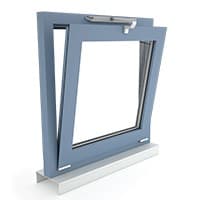
D+H ACB façade window drive Modbus RTU based for natural ventilation
Controls ACB façade window drives for automated natural ventilation via Modbus RTU.
This template interfaces with D+H ACB facade window drives over Modbus RTU. It reads actual position, end position status, condition codes, and electrical values. It also provides control over nominal position, target speed, and drive commands for automated natural ventilation.
- Protocol
- Modbus RTU
- Connection
- RS485, 19200 baud
- Registers
- 10, read and write
- Brand
- D+H Mechatronic AG
- Key readings
- Actual position · End position OPEN · End position CLOSED · Condition code · Failure · Current and Voltage
- Available commands
- Nominal control command · Nominal position · Target speed
- Compatible models
- CDC-ACB · VCD-ACB · ZA-ACB · KA-ACB · CDP + ACB-BSY+-GW · LDx-ACB · DXD + ACB-BSY+-GW · CDM-ACB
- Last updated
Registers (10)
7 read, 3 write
| Name | Unit | Access | Address (Hidden until you enter your email) | Function (hidden) | Type (hidden) |
|---|---|---|---|---|---|
| Actual position | % | Read | |||
| Condition code | Read | ||||
| Current | mA | Read | |||
| Voltage | V | Read | |||
| End position CLOSED | Read | ||||
| Failure | Read | ||||
| End position OPEN | Read | ||||
| Nominal control command | Write | ||||
| Nominal position | % | Write | |||
| Target speed | mm/s | Write |
Loading registers…
Send your device list
If a device is not in the library yet, we build the template for free as soon as we have the register data.
Use cases
- Monitor actual window position and end position status on a live dashboard for each facade zone.
- Create an alert when a drive reports a failure or condition code indicating maintenance is needed.
- Remotely set nominal position and target speed to adjust natural ventilation schedules without a site visit.
- Track current and voltage readings per drive to detect mechanical obstructions or aging components early.
- Control multiple synchronous groups across a building facade from a single ModbusCloud project.
- Log historical position data to verify compliance with ventilation requirements in commercial buildings.
Installation
Wire the Modbus RTU bus (A, B, GND) from the D+H ACB drives or ACB gateway module to the RS-485 port on your ModbusCloud Gateway.
Configure the Modbus RTU settings on the gateway to 19200 baud, odd parity, matching the ACB drive defaults.
Assign unique Modbus slave addresses to each ACB drive or synchronous group according to the D+H configuration tool.
Import the D+H ACB facade window drive template in the ModbusCloud portal and map each slave address to the corresponding device.
Verify communication by checking that actual position and end position registers return valid data on the ModbusCloud dashboard.
Test control commands by sending a nominal position value and confirming the window drive moves to the expected position.
Things to watch for
What baud rate and parity settings do the D+H ACB drives use?
The default is 19200 baud with odd parity (1 stop bit). Make sure your ModbusCloud gateway RS-485 port matches these settings exactly.
How many drives can I connect on one Modbus RTU bus?
Up to 32 D+H ACB drives can operate on a single Modbus RTU extension. Each drive or synchronous group needs a unique slave address.
Can I control multiple drives on the same window as one unit?
Yes. Up to 8 opening drives and 4 lock drives can be synchronised per window. The synchronous group shares one Modbus address and responds as a single unit.
Which D+H drive models are compatible with this template?
Compatible models include CDC-ACB, VCD-ACB, ZA-ACB, KA-ACB, CDP + ACB-BSY+-GW, LDx-ACB, DXD + ACB-BSY+-GW, and CDM-ACB.
Want to see how it works?
