








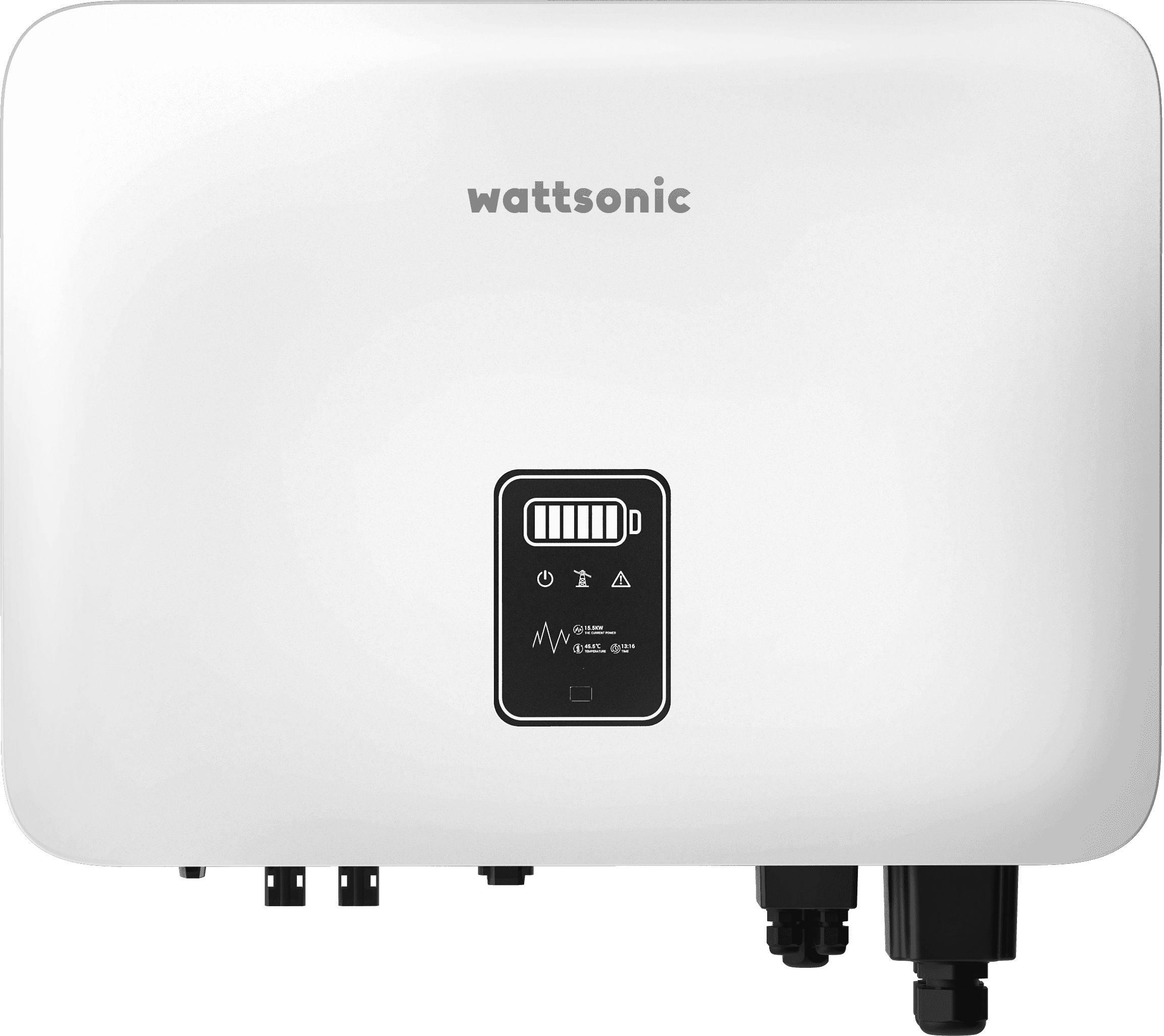
Wattsonic Wattsonic GEN3 (grid)
The Wattsonic GEN3 is a three-phase hybrid inverter and all-in-one energy storage system, available from 4 kW to 20 kW, designed for residential and light-commercial solar-plus-storage installations. This ModbusCloud template targets the grid-metering view of the Wattsonic GEN3 over Modbus TCP, reading total grid exchange power, per-phase active powers on phases A, B, and C, and per-phase currents on all three phases. With these seven registers live in your portal, you can track import and export balance across each phase in real time and catch load asymmetries before they cause grid-code issues.
- Protocol
- Modbus TCP
- Connection
- Ethernet, Modbus TCP
- Registers
- 7, read only
- Brand
- Wattsonic
- Last updated
Registers (7)
7 read, 0 write
| Name | Unit | Access | Address (Hidden until you enter your email) | Function (hidden) | Type (hidden) |
|---|---|---|---|---|---|
| power | W | Read | |||
| currents_a | A | Read | |||
| currents_b | A | Read | |||
| currents_c | A | Read | |||
| powers_a | W | Read | |||
| powers_b | W | Read | |||
| powers_c | W | Read |
Loading registers…
Send your device list
If a device is not in the library yet, we build the template for free as soon as we have the register data.
Use cases
- Monitor total grid exchange power in real time to verify the installation is not unexpectedly importing during peak solar hours.
- Track per-phase active powers on phases A, B, and C to detect and report load imbalances across the three-phase supply.
- Alert on sustained grid import above a threshold to identify when battery discharge or PV production has dropped below site consumption.
- Compare phase currents on all three phases over time to spot gradual asymmetry caused by single-phase load additions.
- Report daily grid export totals per phase to support feed-in tariff verification and site energy audits.
Installation
Enable Modbus TCP on the Wattsonic GEN3 by fitting the optional LAN dongle; the inverter then exposes a Modbus TCP server on port 502 at its local IP address with unit ID 255.
Connect the Wattsonic GEN3 LAN dongle to the same local network as the ModbusCloud Gateway, and note the inverter's IP address from your router's DHCP lease table.
In the ModbusCloud portal, add a new device, select the Wattsonic GEN3 (grid) template, enter the inverter's IP address, set port to 502, and set the Modbus unit ID to 255.
Verify the connection by checking the live value for the power register in the portal; a non-zero signed integer matching your site's current grid import or export confirms correct communication.
Things to watch for
All registers return an illegal data address error. Why?
Some Modbus client tools require a one-based address offset, meaning you must add 1 to every register address listed in the documentation. The addresses in this template are already zero-based and correct for direct FC3 reads. Confirm your gateway is not applying an additional offset.
Phase current values look ten times too high. What is wrong?
The currents_a, currents_b, and currents_c registers return raw uint16 values that must be divided by 10 to obtain amperes. If your integration is displaying the raw integer directly without applying the 0.1 scale factor, all current readings will appear ten times larger than the real value.
The gateway connects but no data arrives. What should I check?
The Wattsonic GEN3 LAN dongle must be present and active; the RS485 port alone does not expose Modbus TCP. Confirm the inverter IP is reachable from the ModbusCloud Gateway on port 502, that the unit ID is set to 255, and that no firewall or VLAN is blocking the connection.
Total power reads negative when I expect export. Is the sign correct?
The sign convention on the power and per-phase power registers can vary with firmware version and how the template consumer applies scaling. Check whether your integration applies a scale of negative one. If the inverter is exporting and the value is negative, a scale factor of negative one in the portal configuration will correct the displayed direction.
Want to see how it works?
