









Wattsonic wattsonic (grid)
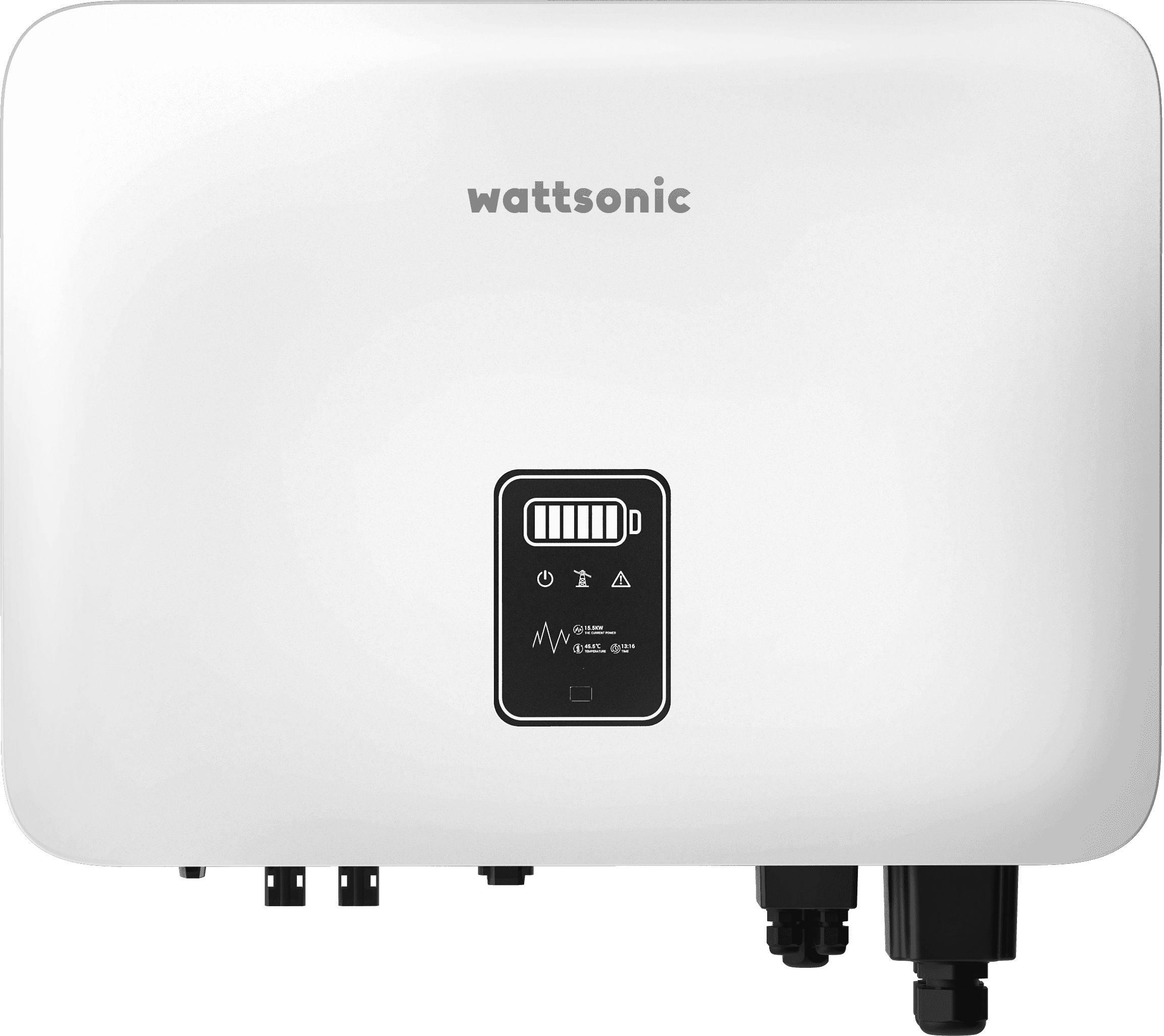
The Wattsonic hybrid inverter is a three-phase residential energy storage system combining PV conversion, battery management, and grid metering in one unit. This template reads grid-side data from the wattsonic over Modbus TCP: total grid exchange power, per-phase active power across phases A, B, and C, and per-phase grid currents for all three phases. Together these seven registers give installers a complete real-time picture of what the site is importing or exporting at any moment. Use it in the ModbusCloud portal to track load imbalance, verify grid connection quality, and feed site-level energy dashboards.
- Protocol
- Modbus TCP
- Connection
- Ethernet, Modbus TCP
- Registers
- 7, read only
- Brand
- Wattsonic
- Compatible models
- wattsonic
- Last updated
Registers (7)
7 read, 0 write
| Name | Unit | Access | Address (Hidden until you enter your email) | Function (hidden) | Type (hidden) |
|---|---|---|---|---|---|
| power | W | Read | |||
| currents_a | A | Read | |||
| currents_b | A | Read | |||
| currents_c | A | Read | |||
| powers_a | W | Read | |||
| powers_b | W | Read | |||
| powers_c | W | Read |
Loading registers…
Send your device list
If a device is not in the library yet, we build the template for free as soon as we have the register data.
Use cases
- Monitor total grid exchange power in real time to verify self-consumption targets are being met on site.
- Track per-phase active power on phases A, B, and C to detect and report load imbalance across the installation.
- Alert on sustained grid import during peak-tariff hours to prompt manual or automated load shifting.
- Compare phase currents over time to identify gradual asymmetry caused by single-phase loads added after commissioning.
- Report daily grid import and export totals across multiple Wattsonic sites from a single ModbusCloud portal overview.
Installation
Connect the Wattsonic inverter's LAN monitoring dongle to your local network router using a standard Ethernet cable, then confirm the inverter receives a local IP address via DHCP or assign a static address through the inverter display menu.
Log into the ModbusCloud portal, add a new ModbusCloud Gateway on the same LAN segment as the inverter, and enter the inverter's IP address with TCP port 502.
Import the Wattsonic wattsonic (grid) template in the portal, assign Modbus unit ID 255, and save the device configuration.
Trigger a manual poll in the portal and spot-check the power register at address 11000: a non-zero signed value confirms Modbus TCP communication is working correctly.
Things to watch for
All registers return zero or no data after connecting. What is wrong?
Confirm the inverter's LAN dongle has a valid IP and is reachable from the ModbusCloud Gateway by pinging it. The inverter exposes Modbus TCP on port 502 with unit ID 255. Any other unit ID will return no response. Also verify the dongle is fully booted, which can take up to two minutes after power-on.
Phase current values look ten times too large. Is the scaling wrong?
The phase current registers (11010, 11012, 11014) return raw uint16 values that must be divided by 10 to obtain amperes. If your integration or dashboard displays the raw register value without applying a 0.1 scale factor, the readings will appear inflated by a factor of ten.
The total power register reads an unexpected large negative number at midday. Why?
Register 11000 is a signed int32. Some integrations apply an additional scale of -1 to align with a positive-import convention. Check whether your portal configuration or any upstream software is inverting the sign. The raw register value follows the inverter's own sign convention, which may differ from your expected display orientation.
The gateway connects but readings drop out intermittently. How do I fix this?
The Wattsonic LAN dongle's Modbus TCP implementation can produce timeouts under continuous high-frequency polling. Set the poll interval to at least 10 seconds and use a 10-second read timeout. Reducing concurrent connections to one also helps, as the dongle handles sustained polling better with lower request rates.
Want to see how it works?
