



On this page
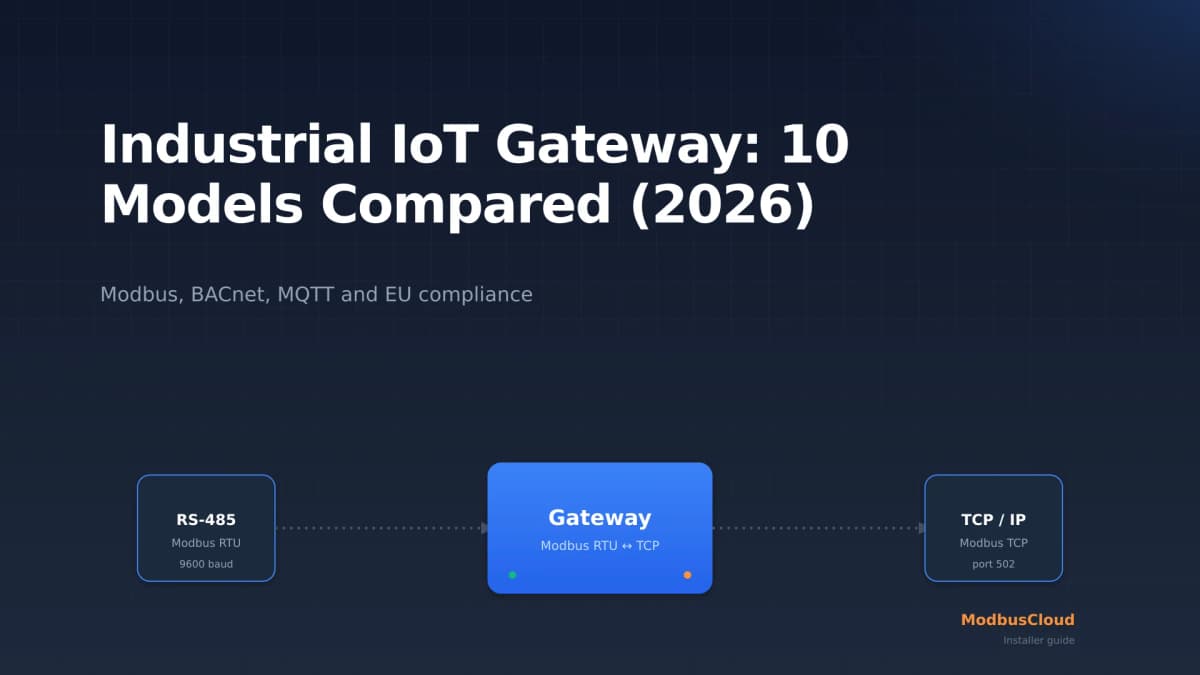
A Modbus cloud platform never reads the RS485 bus itself. A gateway or a piece of software always sits in between, polls the registers as Modbus master and forwards the values. ThingsBoard, AnyViz, Datacake, Teltonika RMS, IXON and Eziwan differ in three things: the hardware you install on site, the unit they bill on, and where the data is stored. The prices below are the ones each vendor listed on its own website on 19 October 2026.
Six platforms by hardware, billing unit and entry price
The table lists what reads the bus, what the vendor bills on and what the entry tier costs.
| Platform | What reads the Modbus bus | Billed per | Entry tier | Your own brand |
|---|---|---|---|---|
| ThingsBoard Cloud | ThingsBoard IoT Gateway, software on your own hardware | device, monthly | Free up to 5 devices; Prototype EUR 45 (USD 49) a month up to 50 | from Pilot, EUR 145 (USD 149) a month |
| Teltonika RMS | a Teltonika router or gateway | device, with credits or 3, 5 or 10-year packages | 30-day trial per device | custom RMS version available |
| IXON Cloud | an IXON router over Modbus TCP | machine, one-year minimum term | Machine Insights Live USD 200 a month, no history | Service Portal, USD 625 a month |
| AnyViz | Universal Cloud Adapter on your own Windows or Linux hardware, or the AnyViz IoT Gateway | tag and recording, invoiced three months ahead | packages shown only after sign-up | OEM edition with own domain |
| Datacake | a LoRaWAN Modbus bridge such as the Adeunis Modbus | device, monthly | 5 devices free; Hobby EUR 25 a month up to 25 | from Light, EUR 159 a month |
| Eziwan | its own Eziwan Gateway with RS-485 | quote | no price list, quote within 24 hours | included for fleets of 50 or more gateways |
Sources: pricing and product pages of ThingsBoard, Teltonika Networks, IXON, AnyViz, Datacake and Eziwan, read on 19 October 2026. ThingsBoard lists euros for its Europe region and dollars for North America; IXON lists dollars only.
The six come from different starting points. IXON, based in the Netherlands, builds for machine builders who operate their machines at customer sites. Teltonika RMS is the management system for Teltonika's own routers. Datacake, from Germany, is built around LoRaWAN sensors. ThingsBoard and AnyViz are general IoT platforms where you build the dashboards yourself. Eziwan, a French vendor, sells gateway, cloud and SIM card as one package, with its website and support in French.
A gateway or software always sits between the bus and the platform
Every platform needs a step in between: the Modbus master that polls the registers. That step comes in four kinds.
Modbus and MQTT work at different points in the chain. Modbus is the request and response protocol on the bus: the master asks for a register and the device answers. MQTT or HTTPS is what the gateway uses to send the values it has read to the platform. The platform never sees a Modbus frame, only the values with a timestamp.
The choice of that middle step decides who maintains it. With software on your own hardware, the operating system, the updates and the RS485 adapter are your job. A vendor gateway puts all of that in one box, and ties you to that hardware. Teltonika's own wiki puts it plainly: "RMS can not directly get the information from 3rd party devices". The router reads the Modbus value, and RMS fetches it from an API endpoint on the router through a monitoring template, one per value.
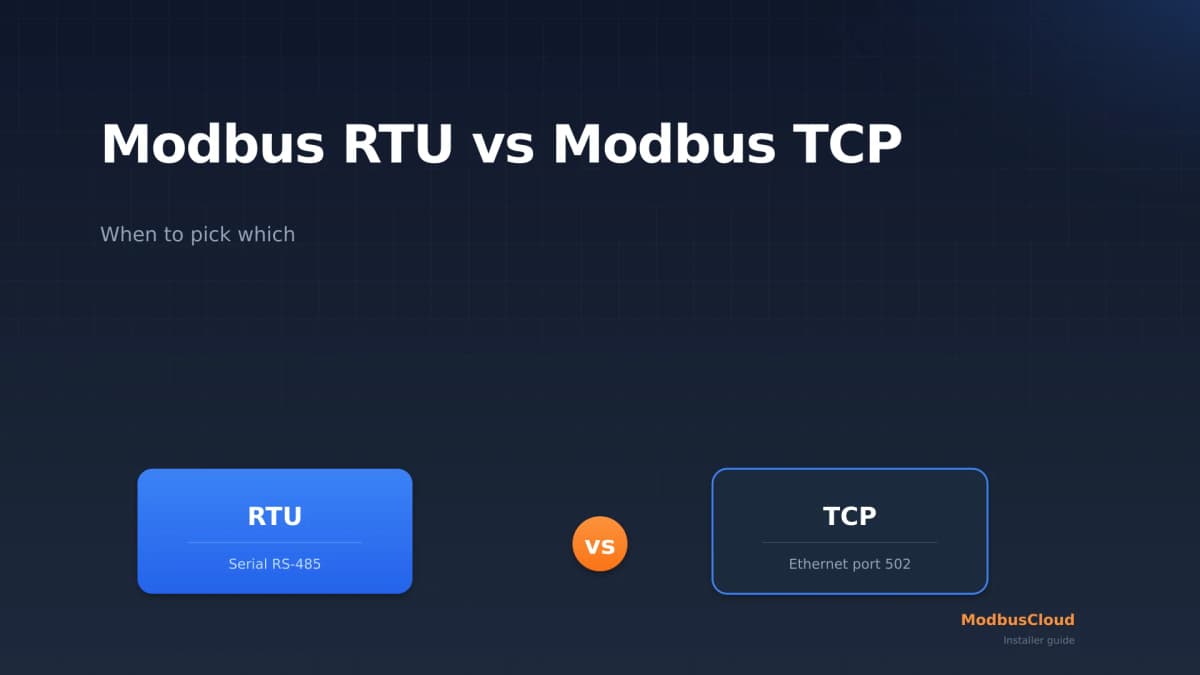
If the device sits on RS485 and the platform only takes Modbus TCP, you need a serial converter. IXON is a case in point: its data logging documentation lists OPC-UA, Modbus TCP and Siemens S7. The difference between the two Modbus variants is covered in Modbus RTU vs Modbus TCP.
What a Modbus cloud platform counts decides the cost of a site
The same installation has a different price on each platform because each one counts something different. Take one gateway with six energy meters that each deliver twenty registers.
ThingsBoard counts devices, according to its pricing page. Its licence defines a device as any source of data, "whether connected directly or through any gateway". Six meters behind one gateway are six devices. The free plan stops at five, so you land in Prototype: EUR 45 a month for up to 50 devices and 10 million data points. ThingsBoard defines a data point as a single measurement, such as "temperature=22".
AnyViz bills on tags and on the recording you switch on per tag. If the adapter reads twenty registers per meter, that is 120 tags. AnyViz shows its standard packages only after you register in its portal and invoices three months in advance.
IXON counts machines, according to its pricing page. Machine Insights Live costs USD 200 a month and shows live data. Storing history starts at the PoC tier, for 25 machines, priced on request. A monthly report for your customer needs that history. IXON asks for a one-year minimum term, billed quarterly or yearly.
Teltonika RMS bills per device. After the 30-day trial you buy 30-day credits or a 3, 5 or 10-year package. Each company gets the first 5 GB of Connect and VPN data free. Datacake bills per device and keeps data for one year, or two with an add-on.
ThingsBoard moved to the Business Source License with version 4.4
On 29 September 2026 ThingsBoard merged its Community Edition and Professional Edition into one product under the Business Source License 1.1. Up to version 4.3 the Community Edition was open source under Apache 2.0. From 4.4 the source code is public, with limits on free use.
Commercial use stays free for up to 100 devices on one server, as long as the ThingsBoard name, logo and "Powered by ThingsBoard" stay visible. Replacing them with your own brand needs a commercial licence, even below 100 devices. Each release becomes Apache 2.0 four years after it ships.
An installer who self-hosts ThingsBoard for several customers adds up every Modbus device across them. According to ThingsBoard, version 4.3 gets security updates until 20 July 2027. The ThingsBoard IoT Gateway, the software that reads the Modbus bus, is a separate project and is still under Apache 2.0.
Register addresses and other set-up traps
AnyViz and IXON count register addresses from 0. If a meter manual lists register 40001, you enter 0 on the platform.
Drop the leading 4 and subtract 1: 40001 becomes 0.
A wrong offset produces no error. The platform reads the neighbouring register and shows a value that looks plausible. With 32-bit values spread over two registers, you get half of one value joined to half of the next.
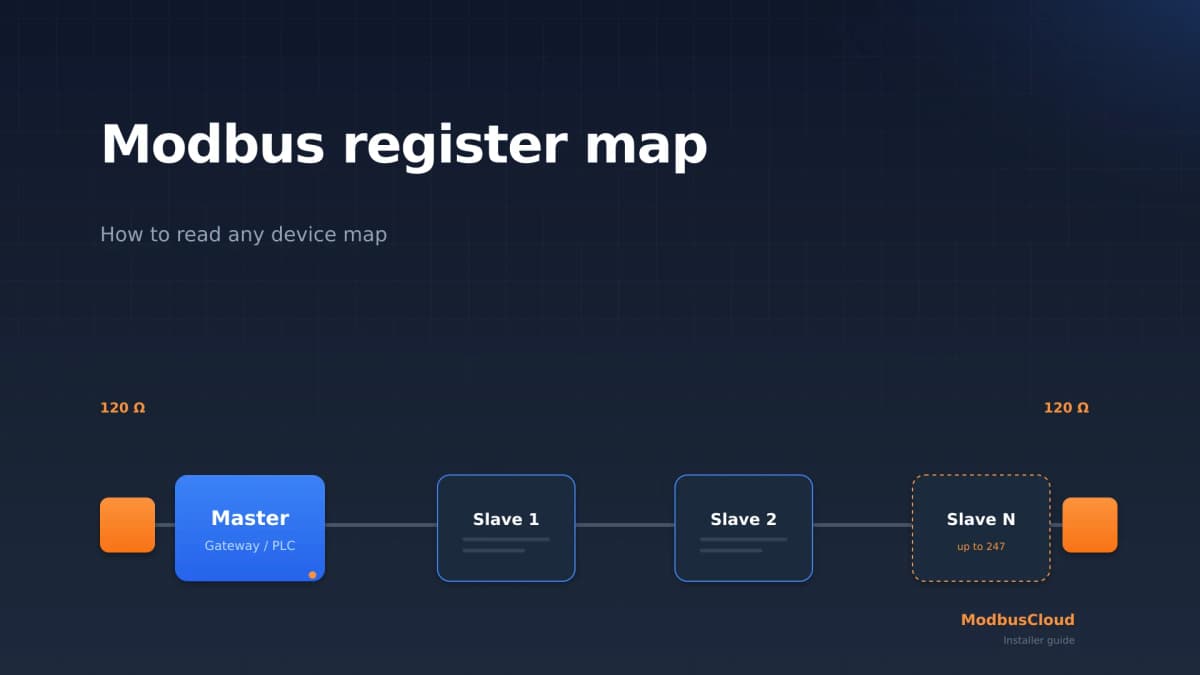
How register numbers relate to addresses is explained in Modbus register map explained.
AnyViz states on its Modbus page a limit of 30 slaves per adapter connection for Modbus RTU. The Modbus over Serial Line specification V1.02 allows 32 devices per RS485 segment without a repeater. If you plan 31 or 32 meters on one bus, ask AnyViz whether you need a second connection.
EU data storage and switching under the Data Act
ThingsBoard, AnyViz and IXON store data in the EU. ThingsBoard runs a separate Europe region (eu.thingsboard.cloud) next to North America, which you pick when you create the account. AnyViz says it stores data only in European data centres, and IXON lists "Data storage within EU". Teltonika only states that RMS is hosted on AWS, without naming a region.
The EU Data Act (Regulation (EU) 2023/2854) applies from 12 September 2025 and covers switching between cloud services offered in the EU. Under Article 25 the notice period is at most two months and the switch must be done within 30 calendar days. After that you have at least 30 calendar days to retrieve your data. Article 29 allows only reduced switching charges until 12 January 2027, and none after that date.
Before you choose, ask in which format the history comes out. An export per register with timestamps loads into another platform or a spreadsheet. Dashboards and rules usually only work on the platform that made them. Another route is to send the data to your own system in parallel, as Eziwan offers with MQTT and InfluxDB. Local and cloud logging are compared in Modbus data logger.
Which platform fits which installer
The choice follows from the hardware already in the field and from what your customer expects.
A machine builder with PLCs and service contracts ends up at IXON, for the VPN access to the controller. Price in the history tier and the Service Portal. If you already run Teltonika routers in the field, RMS manages them. For measured data with history and reports you need a second platform next to it.
An integrator who builds dashboards and runs a server looks at ThingsBoard or AnyViz. Count the Modbus devices or tags first, and read the ThingsBoard licence for version 4.4. Datacake fits a building full of wireless sensors, with Modbus coming in through a LoRaWAN bridge. Eziwan fits when you want gateway, cloud and SIM card from one vendor and French-language support is not a problem.
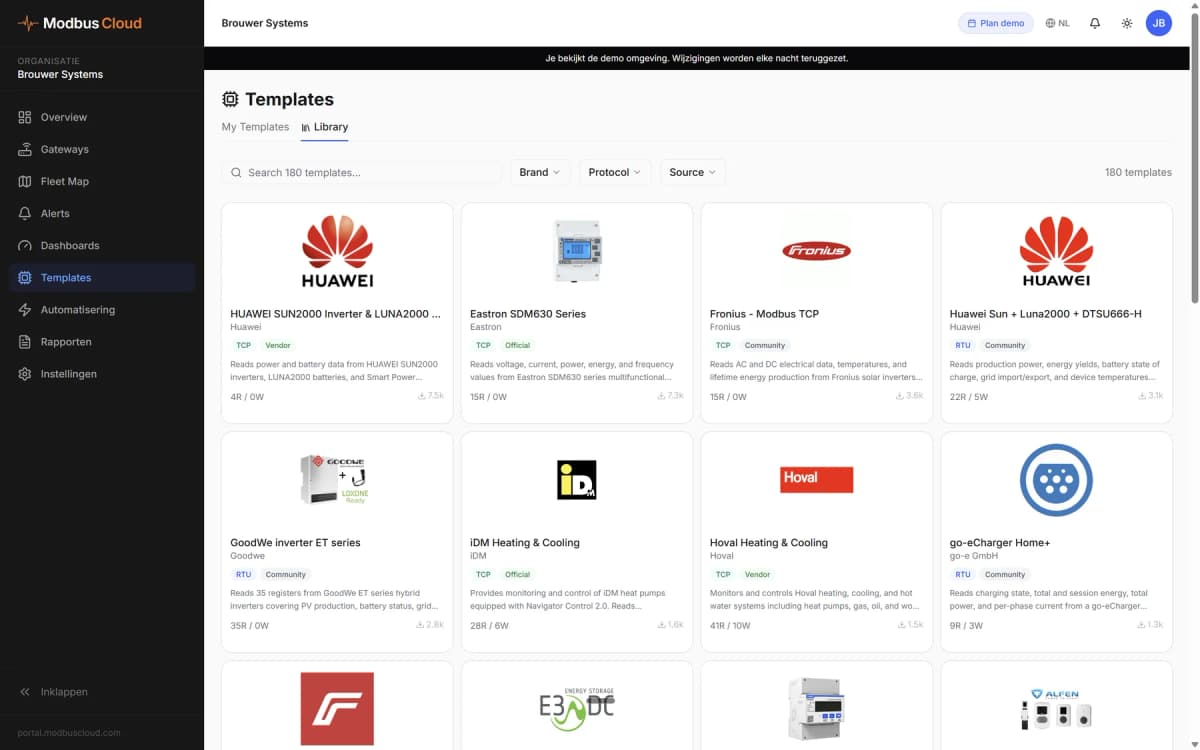
A platform only knows a device's registers when it has a template for that make and model. Otherwise you enter them from the manual. Choosing a gateway independently of the platform is covered in the Modbus gateway buyer guide.
Frequently asked questions
Do I need hardware from the platform vendor?
Not always. IXON, Teltonika RMS and Eziwan work with the router or gateway from the same vendor. ThingsBoard and AnyViz run their Modbus software on a Linux or Windows device you supply, and Datacake receives Modbus data through a LoRaWAN bridge. You always need some step in between that reads the bus.
Is there a free Modbus cloud platform for commercial use?
Yes, within limits. ThingsBoard Cloud is free up to 5 devices, and Datacake for the first 5. Self-hosted ThingsBoard 4.4 is free for commercial use up to 100 devices on one server, with the ThingsBoard logo visible. IXON Remote Access Free costs nothing but has no data logging. Every Modbus device behind a gateway counts.
What is the difference between Modbus and MQTT?
Modbus polls values from devices on a bus; MQTT publishes messages to a server. A gateway reads the registers over Modbus RTU or TCP and publishes the values over MQTT or HTTPS to the cloud platform. The platform therefore never handles Modbus frames, only the values the gateway has read.
Where is the data stored on these platforms?
In the EU for AnyViz, IXON and the ThingsBoard Europe region, according to the vendors' own pages. ThingsBoard also runs a North America region, which you choose when you sign up. Teltonika names AWS as the host for RMS without a region. If your customer requires EU storage, get the region confirmed in writing.
Can I give the platform to my customers under my own brand?
Yes, usually in a higher tier. ThingsBoard Cloud from Pilot (EUR 145 a month), Datacake from Light (EUR 159 a month), IXON with the Service Portal (USD 625 a month). AnyViz offers an OEM edition and Eziwan white label for 50 or more gateways. On self-hosted ThingsBoard 4.4 your own logo needs a licence.
What does the EU Data Act change when I switch platforms?
It caps the notice period at two months and the switch at 30 calendar days. You then get at least 30 days to retrieve your data (Article 25 of Regulation (EU) 2023/2854). Until 12 January 2027 only reduced switching charges are allowed, and none after that. Still ask in which format the history comes out.
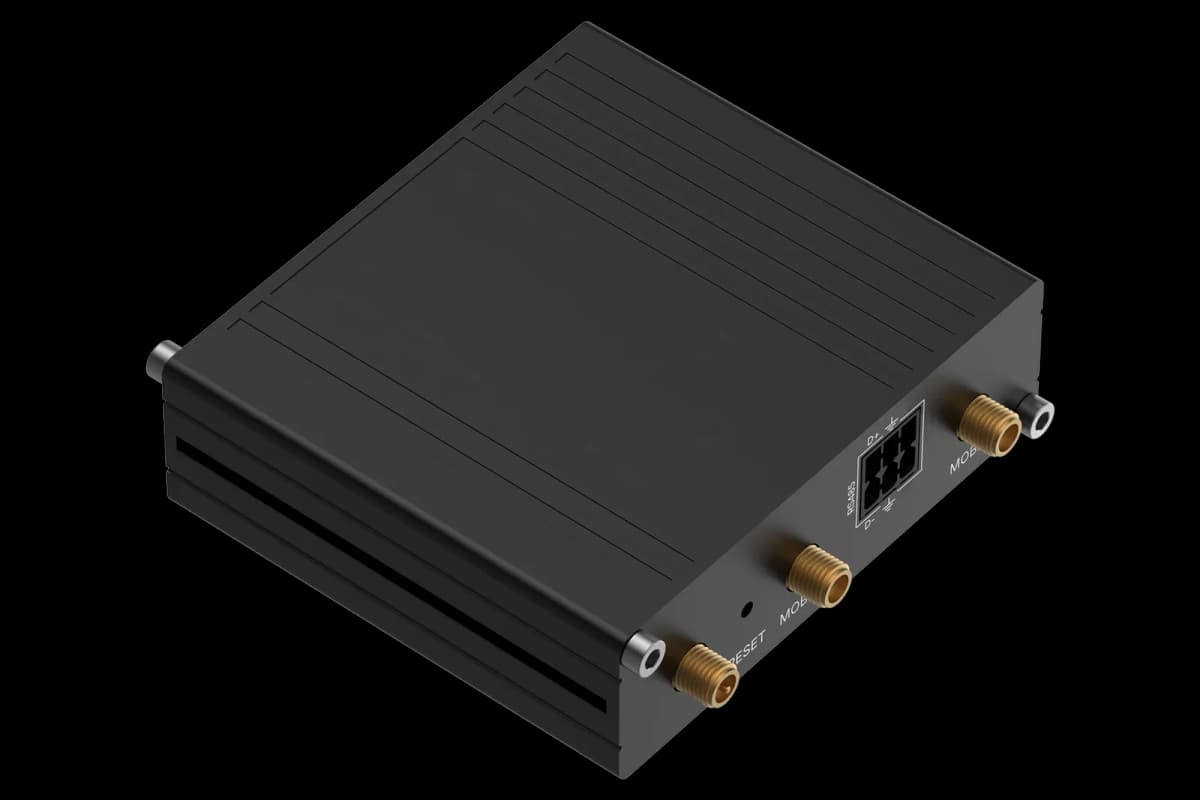
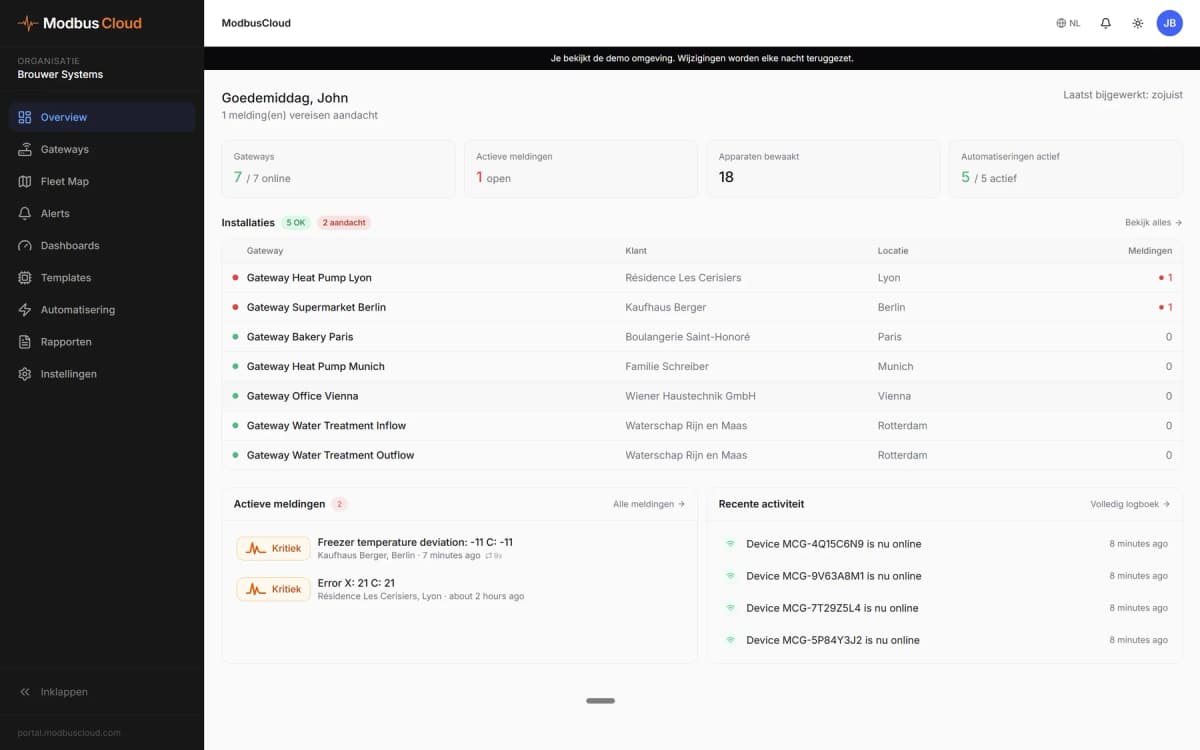
The ModbusCloud Gateway reads Modbus RTU on its own RS485 port and Modbus TCP through its LAN and WAN ports. Values go over MQTT with TLS to a broker in Frankfurt, the data is stored in Ireland and the history is kept for 365 days. The licence applies per gateway, also when several Modbus devices sit behind it. The Gateway costs EUR 295 and the portal licence EUR 149 a year or EUR 495 one-off, with every feature and no tiers. A customer portal in the installer's own branding is part of that licence, and readings download per gateway as CSV or JSON.