




On this page
The rs485 vs rs232 question comes up the moment you wire a Modbus RTU device and find two very different serial ports staring back at you. Both are electrical standards, not protocols, and both carry the exact same Modbus frames. The difference sits one layer down, in how the bits travel on the wire, and that difference decides how many devices you can chain, how far the cable can run, and how well the link survives a noisy plant room. This guide compares RS485 and RS232 the way you meet them in the field: at a heat pump controller, an energy meter, or a legacy configuration port.
You will read what changes between single-ended and differential signalling, how far each reaches, how many nodes each supports, which one Modbus actually expects, and when a gateway is the right way to bring either onto the cloud.
Key points
- RS232 (TIA/EIA-232-F) is a single-ended, point-to-point link: one driver, one receiver, separate TX and RX lines, referenced to ground. Practical reach is about 15 m.
- RS485 (TIA/EIA-485-A) is a differential, multidrop bus: up to 32 unit loads (typically 1 master and 31 slaves) on one twisted pair, up to 1200 m at 19200 baud, with 120 ohm termination at both ends.
- Modbus RTU expects RS485 for any real network. RS232 is fine for a single short point-to-point link. A gateway bridges either serial world to Modbus TCP or the cloud.
Quick verdict: which one do you need?
RS485 and RS232 are physical-layer standards that define voltage levels and wiring, not the meaning of the data. Choose based on device count and distance, not preference.
- Choose RS232 if you connect exactly one device over a short run: a service laptop to a controller, a PLC to one legacy drive, or a configuration port. It is simple, needs no termination, and is full-duplex out of the box.
- Choose RS485 if you have more than one device, a run longer than roughly 15 m, or a noisy environment. Almost every Modbus RTU field network (energy meters, heat pumps, PV inverters) lives on RS485 for exactly these reasons.
At a glance: RS485 vs RS232 compared
The table below lines up the specifications installers ask about most. The values come from the TIA-485-A and TIA-232-F standards and the modbus.org serial-line specification.
| Aspect | RS232 | RS485 |
|---|---|---|
| Standard | TIA/EIA-232-F | TIA/EIA-485-A |
| Signalling | Single-ended (ground referenced) | Differential (balanced pair) |
| Topology | Point to point | Multidrop bus |
| Devices | 1 driver, 1 receiver | 32 unit loads per segment (1 master + 31 slaves) |
| Max cable length | About 15 m | Up to 1200 m at 19200 baud |
| Wires (signal) | TX, RX, GND (full-duplex) | A, B (+ GND ref), 2-wire half-duplex or 4-wire full-duplex |
| Driver voltage | +/-5 to +/-15 V | Differential, receiver threshold +/-200 mV |
| Noise immunity | Low | High (common-mode rejection) |
| Termination | Not required | 120 ohm at both bus ends |
| Typical Modbus role | One short point-to-point link | The standard field bus |
Why does RS485 reach so much further than RS232?
RS485 reaches further because it is differential: it sends a signal as the voltage difference between two wires, A and B, so induced noise hits both wires equally and cancels at the receiver. The receiver reads only the A minus B difference and ignores the shared noise.
RS232 is single-ended. Each line swings between roughly +/-5 and +/-15 V measured against a common ground, and the receiver decides logic level against that ground (its switching threshold is +/-3 V). Any noise coupled onto the line, or any shift in ground potential between the two ends, lands directly on the reading. That is why the recommended RS232 reach stays around 15 m, while RS485 tolerates a common-mode range of -7 V to +12 V and holds signal integrity over 1200 m.
How cable length drops as baud rate rises
On RS485 the maximum cable length is not a single number, it depends on baud rate. Below roughly 100 kbps the ceiling stays near 1200 m; above that it falls roughly inversely with bit rate. Texas Instruments captures the curve in application report SLLA272: at 19200 baud (the de facto Modbus RTU default) you sit safely on 1200 m, and at 1 Mbps you drop to about 120 m.
RS232 has no equivalent curve worth plotting: it tops out near 15 m regardless of baud rate, because the standard actually limits total load capacitance rather than a fixed distance. For any run longer than a room, RS485 is the only serial option that survives the trip. Cable choice matters as much as the standard here, which is why we wrote a dedicated RS485 cable selection guide.
Point to point vs multidrop: the topology that decides it
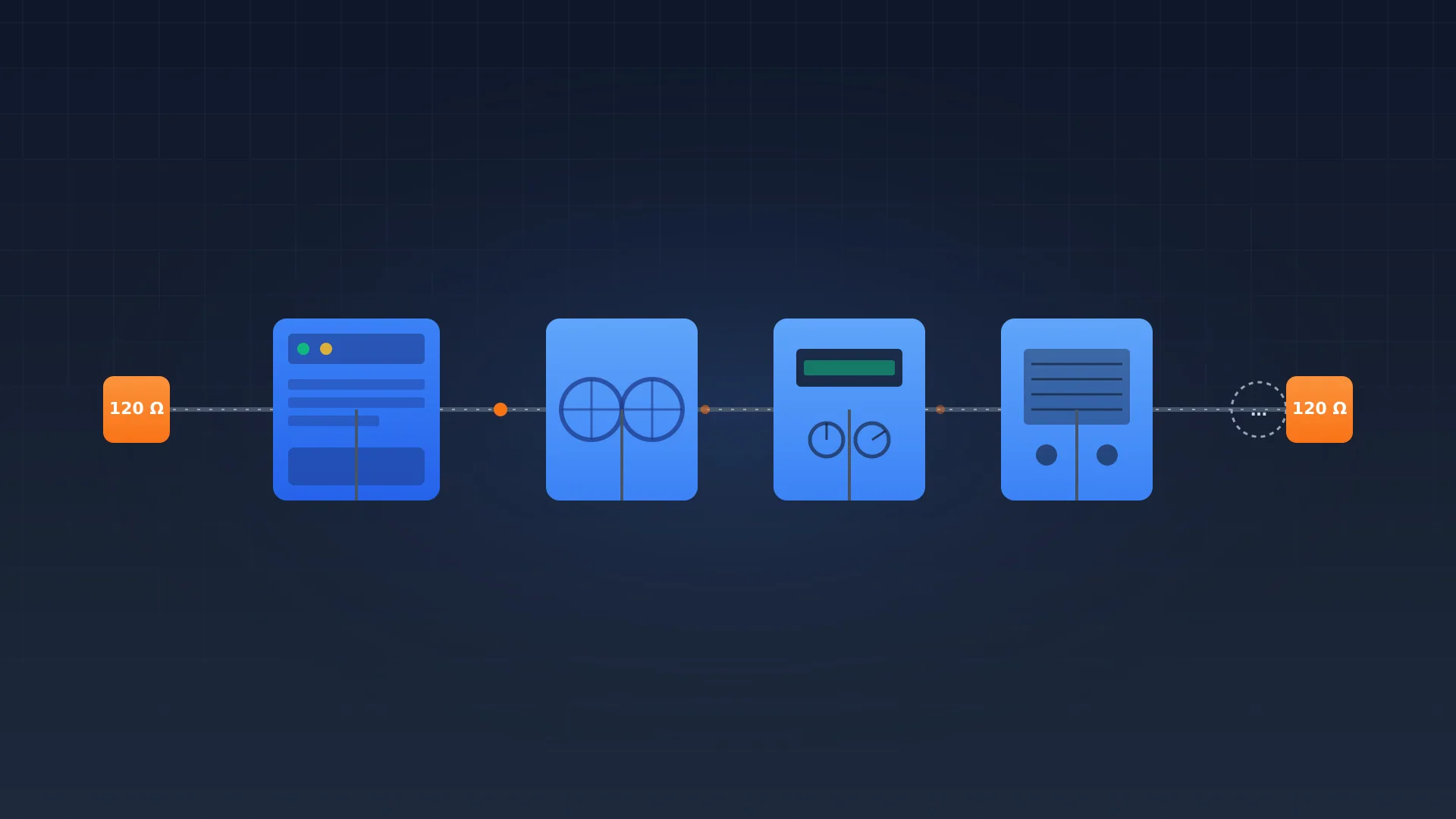
The clearest practical split is topology. RS232 is point to point: it connects exactly two devices, one on each end, and there is no way to add a third without extra hardware. RS485 is multidrop: many devices share one twisted pair, each with its own address, and the master polls them one at a time.
That is why a Modbus RTU network of, say, eight energy meters is unthinkable on RS232 and routine on RS485. The TIA-485-A standard defines 32 unit loads per segment, which in practice means one master plus up to 31 slaves; standard-load transceivers can be pushed to 256 nodes with fractional-unit-load parts or extended with a repeater. Each slave carries a unique address from 1 to 247, exactly as described in our Modbus RTU explained article.
Do RS485 and RS232 use the same settings?
Yes. RS232 and RS485 share the same asynchronous UART framing: a start bit, data bits, an optional parity bit, and a stop bit. So the familiar 9600 8N1 (9600 baud, 8 data bits, no parity, 1 stop bit) means the same thing on both standards. Only the electrical layer underneath changes.
This is good news when you move a device from a bench (RS232 config cable) to a live bus (RS485): the serial parameters carry straight over. If a freshly wired RS485 bus stays silent, the settings are rarely the problem once they matched on the bench; look at polarity, termination and addressing first. When you inherit an installation with unknown settings, an address and baud sweep finds them, as covered in how to scan a Modbus network.
Which does Modbus use, RS232 or RS485?
Modbus uses both, but expects RS485 for networks. The modbus.org Modbus over Serial Line Specification and Implementation Guide V1.02 names RS485 two-wire as the required interface for a Modbus serial line, lists RS485 four-wire as an option, and allows RS232 only for short point-to-point links between two devices.
In the field this maps cleanly. A single controller you configure from a laptop, or one legacy device beside its master, can sit on RS232. Anything with several devices, or any run past a few metres, belongs on RS485. This is a separate question from Modbus RTU versus Modbus TCP, which is about the message wrapper rather than the wire; see Modbus RTU vs Modbus TCP for that decision.
When a gateway is the right answer
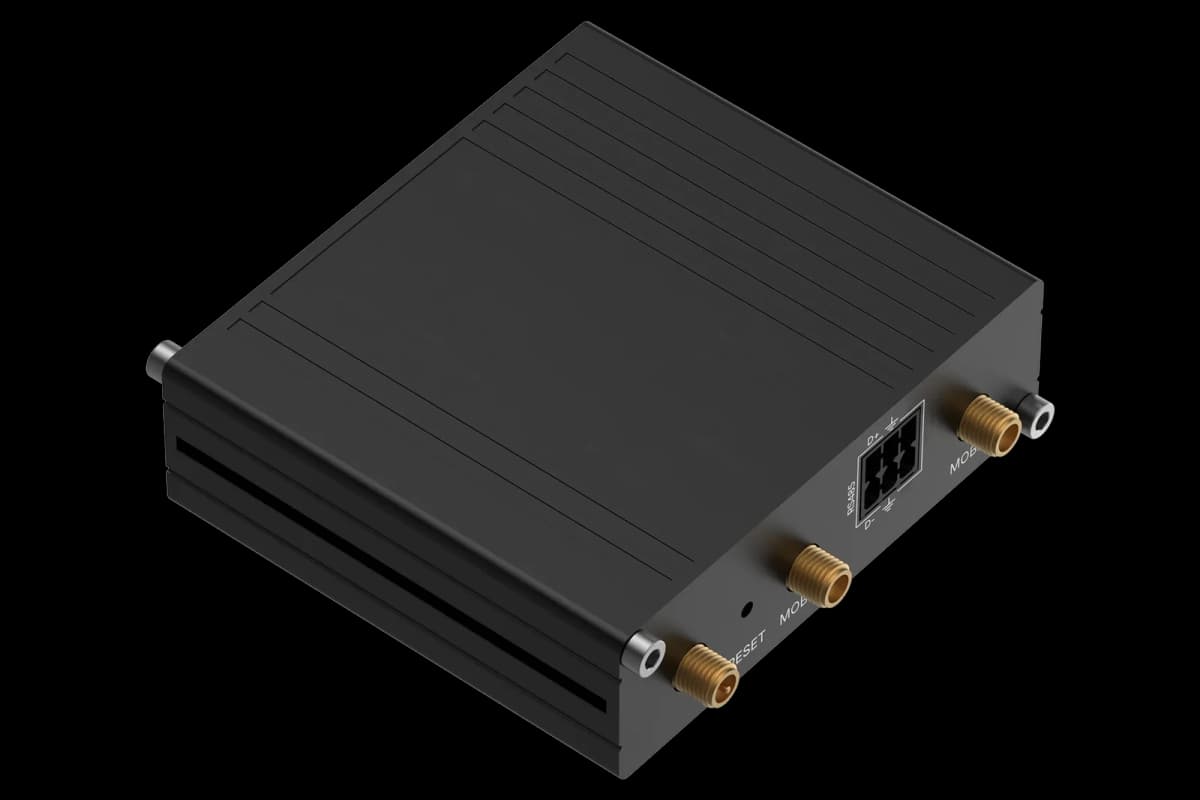
In brownfield sites you often meet both: an RS485 bus of meters plus one RS232 device, and a wish to see all of it in the cloud. A Modbus gateway is the standard bridge. On the serial side it speaks RS485 (or RS232) to the field devices; on the other side it publishes the same registers as Modbus TCP over Ethernet, or pushes them outbound to a cloud platform. The Modbus gateway buyer guide compares the categories in depth.
Frequently asked questions
What is the main difference between RS485 and RS232?
RS232 is single-ended and point to point: one driver and one receiver over separate TX and RX lines, referenced to ground, reaching about 15 m. RS485 is differential and multidrop: up to 32 unit loads share one twisted pair over up to 1200 m. The differential pair gives RS485 its noise immunity and range.
Does Modbus use RS232 or RS485?
Both, but RS485 for networks. The modbus.org Modbus over Serial Line specification V1.02 names RS485 two-wire as the required interface and allows RS232 only for short point-to-point links between two devices. Almost every multi-device Modbus RTU field bus runs on RS485.
Can I convert RS232 to RS485?
Yes, with an RS232-to-RS485 converter. It shifts the single-ended RS232 levels to the differential RS485 pair and, on two-wire RS485, handles transmit and receive direction control automatically or via a control line. Never wire the two standards together directly, because their voltage levels are incompatible.
How many devices can RS485 support compared to RS232?
RS232 supports exactly one device per link, since it is point to point. RS485 supports 32 unit loads per segment under TIA-485-A, which typically means one master and up to 31 slaves. Fractional-unit-load transceivers or a repeater extend this to as many as 256 nodes.
Is RS485 faster than RS232?
At the physical layer RS485 can run faster over distance, up to 10 Mbps at short range versus a standard RS232 rate of 20 kbps. In Modbus RTU practice both commonly run 9600 or 19200 baud, so throughput is similar; RS485 wins on range and device count rather than raw speed.
What is the maximum cable length for RS485 and RS232?
RS485 reaches up to 1200 m at 19200 baud, falling to roughly 120 m at 1 Mbps as the length scales inversely with bit rate above 100 kbps. RS232 stays near 15 m at any baud rate, because its standard limits load capacitance rather than a fixed distance.
Do I need termination resistors for RS485 or RS232?
RS485 needs a 120 ohm termination resistor at each physical end of the bus to match the cable impedance and stop reflections, especially on longer or faster runs. RS232 needs no termination at all, because it is a short point-to-point link rather than a transmission-line bus.
Conclusion
RS485 and RS232 are not rivals so much as two answers to different questions. RS232 is the simple, full-duplex, point-to-point link for one device over a short run, and it still earns its place on configuration ports and legacy connections. RS485 is the differential multidrop bus that carries a whole Modbus RTU field network of meters, heat pumps and inverters over 1200 m with real noise immunity, which is why the Modbus serial specification is built around it. When you need to lift either serial world into the cloud, a gateway with outbound TLS is the clean bridge that leaves your existing wiring exactly as it is.