









SunSpec Model 17 — Serial Interface
SunSpec Model 17 is a standardized configuration model that describes and controls the parameters of a serial communication port on SunSpec-compliant DER devices such as inverters, battery systems, and energy meters. Over Modbus RTU, this template reads the port name, baud rate, data bits, parity, duplex, and flow control settings, and also exposes the read-only interface type and protocol fields. Importing this template into the ModbusCloud portal lets you verify and, where permitted, adjust serial port parameters remotely without physical access to the device.
- Protocol
- Modbus RTU
- Connection
- RS485
- Registers
- 10, read and write
- Brand
- SunSpec
- Last updated
Registers (10)
10 read, 6 write
| Name | Unit | Access | Address (Hidden until you enter your email) | Function (hidden) | Type (hidden) |
|---|---|---|---|---|---|
| id | Read | ||||
| l | Read | ||||
| nam | Read and write | ||||
| rte | bps | Read and write | |||
| bits | Read and write | ||||
| pty | Read and write | ||||
| dup | Read and write | ||||
| flw | Read and write | ||||
| typ | Read | ||||
| pcol | Read |
Loading registers…
Send your device list
If a device is not in the library yet, we build the template for free as soon as we have the register data.
Use cases
- Verify the baud rate register on a newly installed SunSpec device to confirm it matches the RS485 bus configuration.
- Track serial port name assignments across multiple sites to maintain consistent device documentation in your portal.
- Monitor the read-only interface type and protocol fields to confirm correct SunSpec model discovery after firmware updates.
- Alert on unexpected changes to parity or data-bits settings that could cause communication failures on a shared RS485 bus.
- Compare flow control and duplex settings between devices on the same bus to diagnose intermittent read errors.
Installation
Confirm the target device supports SunSpec Model 17 by checking its documentation or scanning the SunSpec model chain starting at Modbus register 40001.
Connect the ModbusCloud Gateway to the RS485 bus using a twisted-pair cable on terminals A and B, ensuring correct termination at both ends of the bus.
In the ModbusCloud portal, add your Gateway, import the SunSpec Model 17 template, and assign the correct Modbus unit ID matching the device address set on the device itself.
Read the id register and confirm it returns 17, then spot-check the rte register to verify the reported baud rate matches your bus configuration.
Things to watch for
The id register returns an unexpected value. What does this mean?
The id register must read 17 for Model 17 to be active at that address. If you receive a different value, the model chain offset is wrong. SunSpec models are not at fixed addresses: scan from register 40001 to find the correct starting offset for each model block, then adjust the base address in your portal configuration.
The gateway connects but rte and bits registers return zeros or NaN. Why?
Some devices mark optional points in Model 17 as not-implemented and return the SunSpec NaN sentinel instead of a real value. Check the device documentation to confirm which points are implemented. Also verify that the unit ID in the portal matches the device's configured Modbus address, as a mismatch produces silent zero responses on some devices.
I am reading garbage on the RS485 bus. Could the pty or dup registers be the cause?
Yes. If the parity or duplex settings reported by the device do not match the RS485 master configuration, framing errors appear as corrupt register values. Read the pty and dup registers first to confirm the device's active settings, then align your gateway or RS485 adapter to match before re-attempting a full poll.
Is it safe to write new values to nam, rte, bits, pty, dup, or flw remotely?
Use caution. Writing a new baud rate or parity setting takes effect immediately on many devices and will disconnect the bus at the old speed, causing the gateway to lose communication until it is reconfigured to match. Always have a fallback plan and test one register change at a time. Some devices also store these settings in non-volatile memory, so excess write cycles can wear the internal storage.
Knowledge base articles for this device

SunSpec Modbus: one register map for many inverters
SunSpec Modbus is the open register map SMA, Fronius, SolarEdge and Kostal share. Learn the layout, int+SF vs float, ports, and reading a mixed fleet.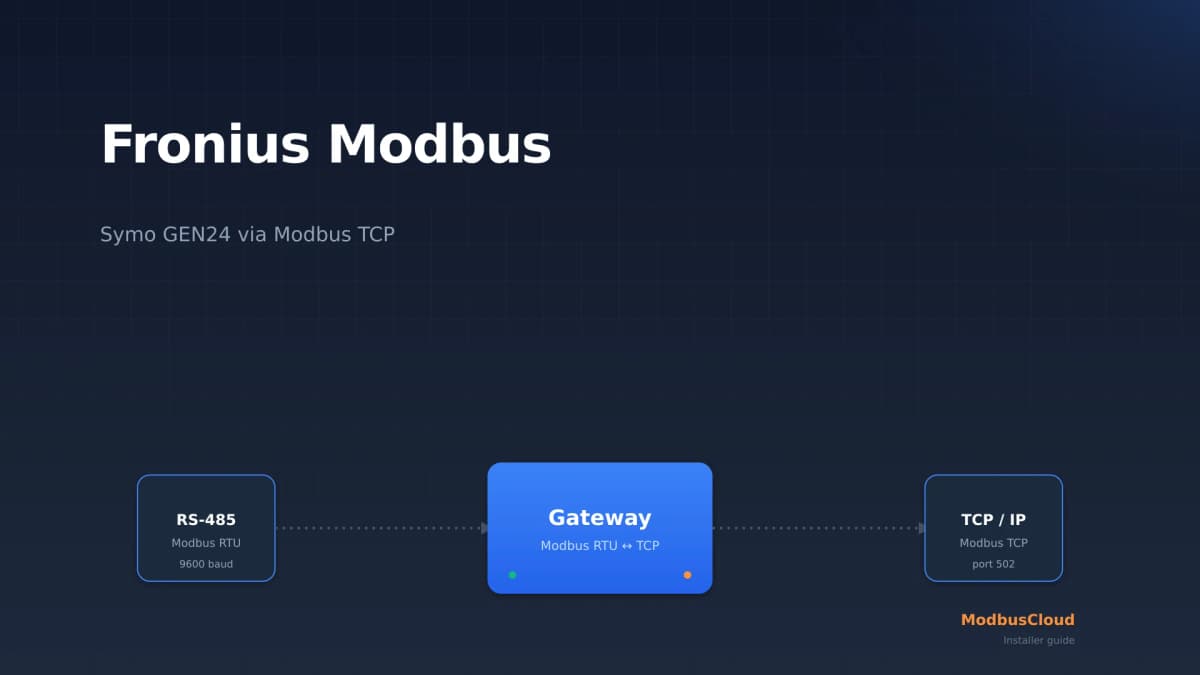
Fronius Modbus: read a Symo GEN24 over Modbus TCP
Fronius Modbus explained: enable Modbus TCP on the Symo GEN24 on port 502, choose between int+SF and float, read the right SunSpec registers and scale them correctly. Practical guide for solar installers.
SMA Modbus: reading a Sunny Boy over Modbus TCP (installers)
SMA Modbus explained: enable the Modbus TCP server on port 502, choose between the SMA profile (unit ID 3) and SunSpec (unit ID 126), read the right registers, and handle the NaN values at night. Practical guide for installers.
Want to see how it works?
