

Landis+Gyr ULTRAHEAT T550
Ultrasonic heat and cooling meter for energy, flow, power and flow and return temperature.
The Landis+Gyr ULTRAHEAT T550 is an ultrasonic heat and cooling meter that measures energy, flow and temperatures in district heating networks and collective installations. This Modbus RTU template reads heat and cooling energy, thermal power, flow rate, flow and return temperature, volume and the error code into ModbusCloud.
- Protocol
- Modbus RTU
- Connection
- RS485, 9600 baud
- Registers
- 23, read only
- Brand
- Landis+Gyr
- Key readings
- Heat energy · Thermal power · Flow rate · Flow temperature · Return temperature · Volume · Error code
- Compatible models
- ULTRAHEAT T550 (UH50) with WZU-485E-MOD · ULTRACOLD T550 (UC50) with WZU-485E-MOD · Landis+Gyr UH50 heat meter, firmware 5.15 or higher · Landis+Gyr UC50 cooling meter · Siemens UH50 with WZU-485E-MOD
- Last updated
Registers (23)
23 read, 0 write
| Name | Unit | Access | Address (Hidden until you enter your email) | Function (hidden) | Type (hidden) |
|---|---|---|---|---|---|
| Flow Temperature | °C | Read | 1 | FC03 | int16 |
| Return Temperature | °C | Read | 2 | FC03 | int16 |
| Temperature Difference | K | Read | 3 | FC03 | int16 |
| Flow Rate | m³/h | Read | 4 | FC03 | int32 |
| Power | kW | Read | 6 | FC03 | int32 |
| Energy | Read | ||||
| Cooling Energy Tariff Register 1 | Read | ||||
| Volume | Read | ||||
| Info Code | Read | ||||
| Header | Read | ||||
| Date and Time | Read | ||||
| Monthly Energy | Read | ||||
| Monthly Volume | Read | ||||
| Tariff Register 1 | Read | ||||
| Tariff Register 2 | Read | ||||
| Tariff Register 3 | Read | ||||
| Serial Number | Read | ||||
| Pulse Input 1 Volume | Read | ||||
| Pulse Input 2 Volume | Read | ||||
| Pulse Input 1 Pulse Value | Read | ||||
| Pulse Input 2 Pulse Value | Read | ||||
| Pulse Input 1 Serial Number | Read | ||||
| Pulse Input 2 Serial Number | Read |
Loading registers…
Send your device list
If a device is not in the library yet, we build the template for free as soon as we have the register data.
Use cases
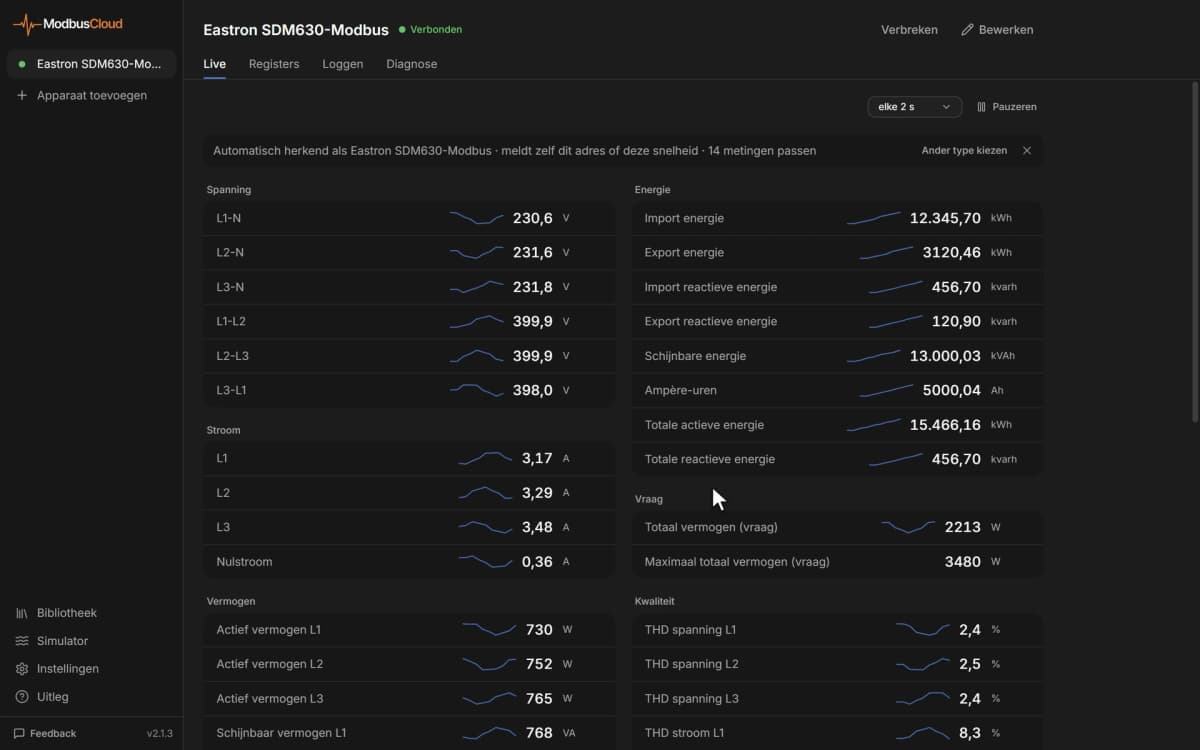
- Show heat energy, power and flow and return temperature of each substation on one ModbusCloud dashboard.
- Send an email or webhook alert as soon as the error code of the meter is no longer 0.
- Keep 365 days of history to spot a poor temperature difference that points to a badly balanced installation.
- Compare monthly energy per building and export the readings as CSV for billing or reporting.
- Get a no data alert when the meter or its module stops answering.
Installation
Place the WZU-485E-MOD module in slot module 1 of the meter and wire its own power supply to 24V and GND.
Connect A+ and B- to the RS485 port of the ModbusCloud Gateway and fit a 120 ohm resistor at the end of the bus.
Set address, speed and parity in the module with the configuration tool over micro USB; the default is 9600 baud, even parity, address 0.
In ModbusCloud, add a Modbus device with the same address and settings and import this template.
Check that the serial number and the flow temperature come in with sensible values.
Things to watch for
The meter does not answer on the bus at all. What should I check?
The module leaves the factory with address 0, which is broadcast and never answers. Give it an address from 1 to 247 in the configuration tool. Then check 9600 baud, even parity, 1 stop bit, swap A and B if needed, and make sure the module has its own power supply on 24V and GND.
Why does the energy value look 10 or 1000 times too small?
The meter stores energy as a whole number in the unit and resolution it was set up with, in MJ or kWh with a power of ten. Read the Header register once and set the scale of the energy and volume registers to match, for example 10 kWh per digit.
Can I read several heat meters on one RS485 line?
Yes. Give every module its own address and the same speed and parity. Use a twisted pair cable, terminate both ends of the bus and keep the module cables short, at most 10 m from module to bus.
Does reading the meter often drain the battery?
On battery powered meters, reading more often than every 10 minutes needs a D cell battery for a 6 year life. The module itself always runs on its own external supply.




Want to see how it works?