


SunSpec Model 143 — LFRTX
SunSpec Model 143 (LFRTX) is a standardised Modbus TCP information model used to configure and monitor low-frequency ride-through behaviour in grid-tied inverters and distributed energy resources (DERs). The template reads the model identifier, block length, number of supported curve sets, points-per-curve capacity, and the time and frequency scale factors. It also exposes the active curve index (actcrv), the module enable flag (modena), transition timers (wintms, rvrttms, rmptms), and the curve-type indicator (crvtype). This gives installers a single-click way to verify that the LFRTX function is correctly armed and configured on any SunSpec-certified inverter.
- Protocol
- Modbus TCP
- Connection
- Ethernet, Modbus TCP
- Registers
- 12, read and write
- Brand
- SunSpec
- Compatible models
- SunSpec Model 144 — HFRTX
- Last updated
Registers (12)
12 read, 5 write
| Name | Unit | Access | Address (Hidden until you enter your email) | Function (hidden) | Type (hidden) |
|---|---|---|---|---|---|
| id | Read | ||||
| l | Read | ||||
| actcrv | Read and write | ||||
| modena | Read and write | ||||
| wintms | Secs | Read and write | |||
| rvrttms | Secs | Read and write | |||
| rmptms | Secs | Read and write | |||
| ncrv | Read | ||||
| npt | Read | ||||
| tms_sf | Read | ||||
| hz_sf | Read | ||||
| crvtype | Read |
Loading registers…
Send your device list
If a device is not in the library yet, we build the template for free as soon as we have the register data.
Use cases
- Verify that the LFRTX modena flag is set to enabled after a firmware update on any SunSpec-certified inverter.
- Monitor the active curve index (actcrv) to confirm the correct low-frequency trip profile is selected per grid code.
- Track the reversion timer (rvrttms) to ensure temporary curve overrides expire within the configured time window.
- Alert on unexpected changes to the crvtype register to detect unauthorised modifications to trip behaviour.
- Compare ncrv and npt values across multiple inverter sites to confirm uniform ride-through curve capacity.
Installation
Enable Modbus TCP on the inverter under the communication or Modbus section of its web interface, and note the assigned IP address and TCP port (default 502).
Connect the inverter to the same local network as the ModbusCloud Gateway, ensuring the gateway can reach the inverter on port 502 with no firewall blocking.
In the ModbusCloud portal, add a new gateway, import the SunSpec Model 143 LFRTX template, and assign the correct Modbus unit ID matching the inverter's configured slave address.
Trigger a single poll and spot-check the id register: a value of 143 confirms the correct SunSpec model block is addressed, and a non-zero ncrv confirms curve sets are available.
Things to watch for
Why does the id register return a value other than 143?
The Modbus base address for SunSpec models is device-dependent. The gateway may be pointing at the wrong offset within the SunSpec model chain. Use a SunSpec discovery scan to locate the correct starting address for model 143, then update the base address in the portal accordingly.
The modena register reads false even though ride-through should be active. Why?
Some inverters require the LFRTX function to be explicitly enabled via their local web interface or a grid-code commissioning tool before the modena bit reflects true over Modbus. Check the inverter's grid protection or grid-code settings menu and enable the low-frequency ride-through function there first.
Frequency values from curve points look wrong after scaling. What is the issue?
Frequency curve point values must be multiplied by 10 raised to the power of hz_sf, which is a signed scale factor (typically negative). Confirm that your data pipeline applies hz_sf correctly. Similarly, time values require tms_sf. Skipping either scale factor produces readings that are off by an order of magnitude.
Is it safe to write actcrv and modena remotely during live operation?
Writing actcrv or modena during live grid operation can immediately change the inverter's protective response to grid frequency deviations. This may cause the inverter to trip or to remain connected outside the intended protection window. Always coordinate write operations with the grid operator, follow the inverter manufacturer's commissioning procedure, and revert to the default curve if in doubt.
Knowledge base articles for this device
SunSpec Modbus: one register map for many inverters
SunSpec Modbus is the open register map SMA, Fronius, SolarEdge and Kostal share. The layout, int+SF vs float, the TCP port per brand and reading a mixed fleet.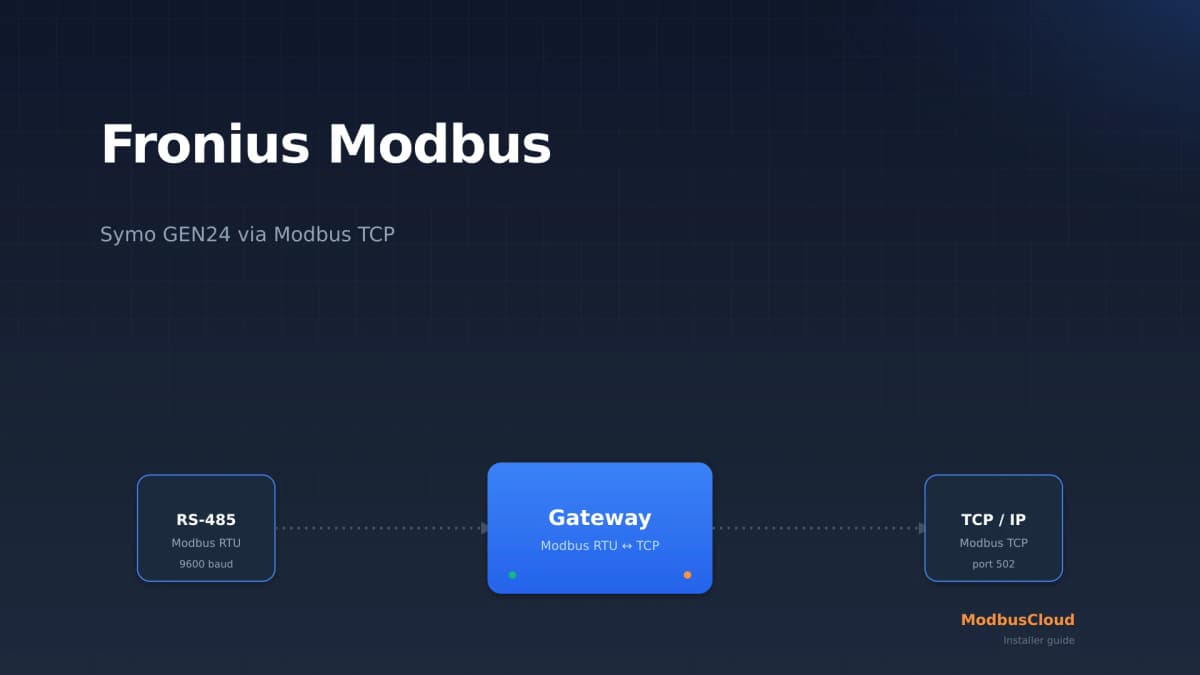
Fronius Modbus: read a Symo GEN24 over Modbus TCP
Fronius Modbus explained: enable Modbus TCP on the Symo GEN24 on port 502, choose between int+SF and float, read the right SunSpec registers and scale them correctly. Practical guide for solar installers.
SMA Modbus: reading a Sunny Boy over Modbus TCP (installers)
SMA Modbus explained: enable the Modbus TCP server on port 502, choose between the SMA profile (unit ID 3) and SunSpec (unit ID 126), read the right registers, and handle the NaN values at night. Practical guide for installers.
Want to see how it works?