



SunSpec Model 707 — DER Trip LV
SunSpec Model 707 — DER Trip LV is an open, IEEE 1547-2018-aligned information model that configures and monitors the low-voltage trip disturbance response settings of grid-connected distributed energy resources. The template communicates over Modbus TCP and exposes the model's control header: enable state, curve adoption request and result, curve geometry metadata (npt, ncrvset), and the voltage and time scale factors used to decode raw curve-point values. Using this template in the ModbusCloud portal, installers and asset managers can verify that a DER's low-voltage trip function is active and that the correct trip curve is engaged, supporting grid-compliance audit trails for solar inverters and battery storage systems covered by SunSpec Model 708 — DER Trip HV.
- Protocol
- Modbus TCP
- Connection
- Ethernet, Modbus TCP
- Registers
- 9, read and write
- Brand
- SunSpec
- Compatible models
- SunSpec Model 708 — DER Trip HV
- Last updated
Registers (9)
9 read, 2 write
| Name | Unit | Access | Address (Hidden until you enter your email) | Function (hidden) | Type (hidden) |
|---|---|---|---|---|---|
| id | Read | ||||
| l | Read | ||||
| ena | Read and write | ||||
| adptcrvreq | Read and write | ||||
| adptcrvrslt | Read | ||||
| npt | Read | ||||
| ncrvset | Read | ||||
| v_sf | Read | ||||
| tms_sf | Read |
Loading registers…
Send your device list
If a device is not in the library yet, we build the template for free as soon as we have the register data.
Use cases
- Verify that the low-voltage trip function is enabled on each DER after commissioning to confirm grid-code compliance.
- Monitor the adptcrvrslt register after a curve change to confirm the new trip curve was adopted successfully.
- Track the ena register across a fleet of inverters to detect any device where the trip function has been inadvertently disabled.
- Compare ncrvset values across sites to confirm that the expected number of configurable trip curve slots is present on each device.
- Alert when adptcrvrslt returns a FAILED status so that misconfigured trip settings are caught before the next grid disturbance event.
Installation
Enable Modbus TCP on the target DER device through its web interface or commissioning tool, typically under the communication or Modbus section, and note the TCP port (default 502) and the unit ID.
Connect the DER to the same local network as the ModbusCloud Gateway, ensuring the Gateway can reach the device IP address on the configured Modbus TCP port.
In the ModbusCloud portal, add the Gateway, create a new device, import the SunSpec Model 707 — DER Trip LV template, and enter the device IP address and unit ID.
Trigger a read poll and spot-check the id register: a value of 707 confirms the model is correctly addressed; verify ena reads 1 to confirm the trip function is active.
Things to watch for
The id register returns 0 or an unexpected value. What is wrong?
SunSpec models are discovered dynamically starting at a base address, typically 40001. If the model offset is wrong, the id register will not return 707. Use SunSpec auto-discovery or confirm the exact model start address in the device documentation before setting the register offset in the portal.
Why do voltage curve-point values look like large integers and not percentages?
Raw voltage point values must be multiplied by 10 raised to the power of v_sf, which is a signed int16 scale factor. Read the v_sf register first, apply the exponent, and the result is the actual voltage as a percentage of nominal. The same logic applies to time values using tms_sf.
The gateway connects but the ena and adptcrvreq registers show no change after writing. What now?
Some DER implementations require the Modbus TCP connection to use a specific unit ID. Confirm the unit ID in the device configuration matches the value set in the portal. Also check that the device firmware supports the 700-series SunSpec profile, as older firmware may only expose 100-series models.
Is it safe to write to the ena and adptcrvreq registers remotely?
Use caution. Writing ena to 0 disables the low-voltage trip function, which may violate grid-interconnection requirements or invalidate grid-code compliance. Writing adptcrvreq to a curve index activates a new trip curve immediately. Always confirm the target curve settings are correct and that the change complies with local grid-code requirements before writing.
Knowledge base articles for this device
SunSpec Modbus: one register map for many inverters
SunSpec Modbus is the open register map SMA, Fronius, SolarEdge and Kostal share. The layout, int+SF vs float, the TCP port per brand and reading a mixed fleet.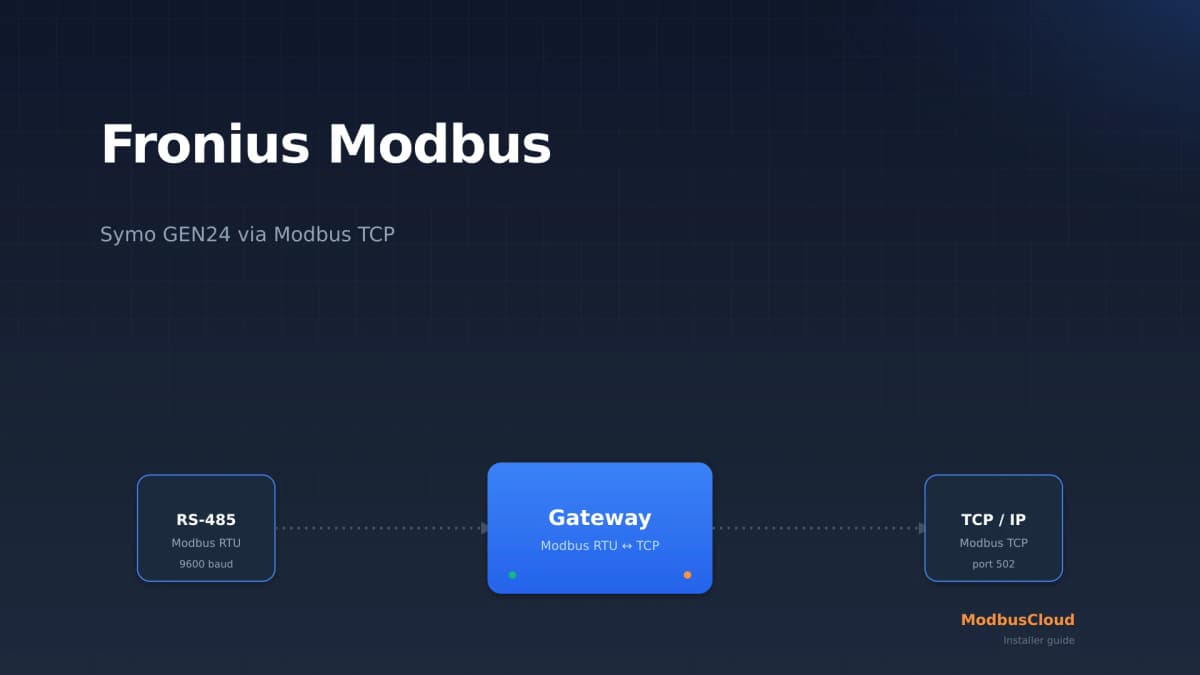
Fronius Modbus: read a Symo GEN24 over Modbus TCP
Fronius Modbus explained: enable Modbus TCP on the Symo GEN24 on port 502, choose between int+SF and float, read the right SunSpec registers and scale them correctly. Practical guide for solar installers.
SMA Modbus: reading a Sunny Boy over Modbus TCP (installers)
SMA Modbus explained: enable the Modbus TCP server on port 502, choose between the SMA profile (unit ID 3) and SunSpec (unit ID 126), read the right registers, and handle the NaN values at night. Practical guide for installers.
Want to see how it works?