

Weidmueller 525
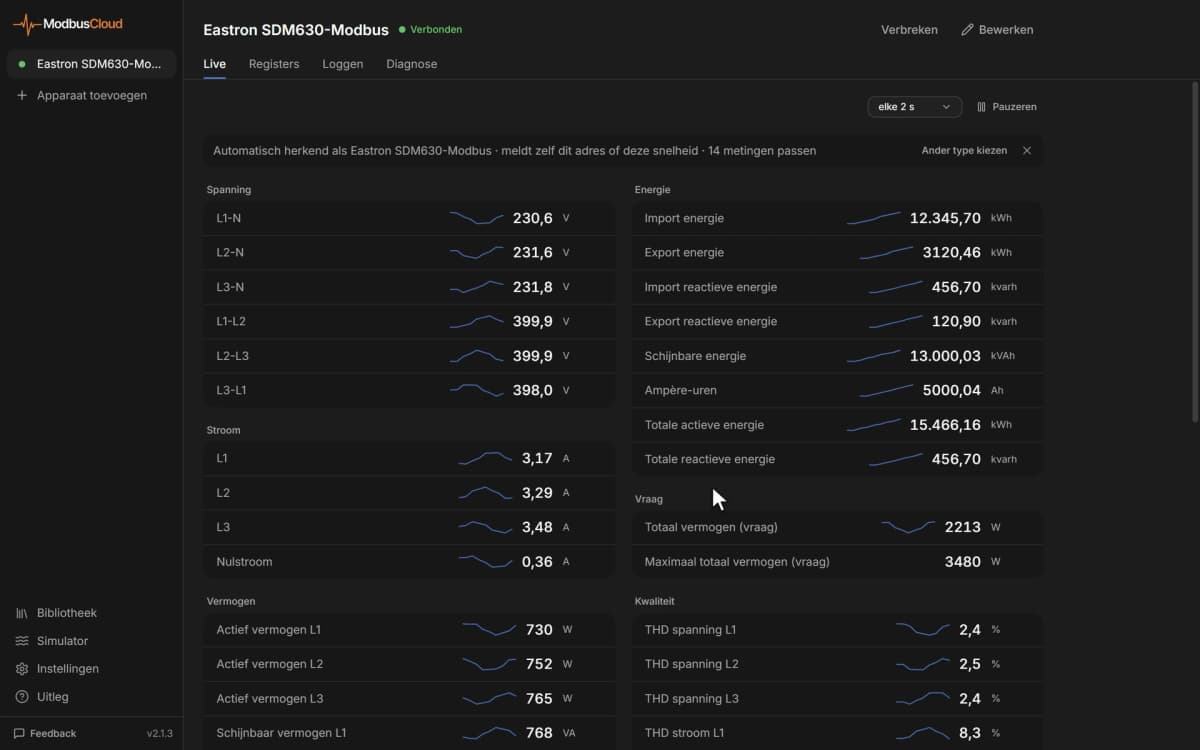
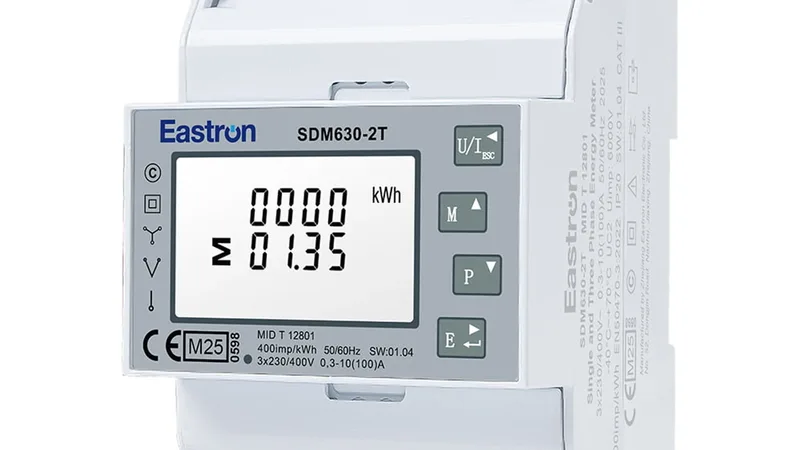
The Weidmueller 525 is a panel-mount, three-phase power quality and energy meter designed for industrial and commercial electrical monitoring. Connected via Modbus TCP, this template reads all three phases for voltage (line-to-neutral and line-to-line), current, active power, apparent power, reactive power, and power factor, as well as cumulative energy registers split by direction (consumed and delivered per phase) and harmonic distortion (THD-U and THD-I per phase). For building managers and energy engineers, the Weidmueller 525 delivers a full electrical picture at 200 ms resolution without additional software.
- Protocol
- Modbus TCP
- Connection
- Ethernet, Modbus TCP
- Registers
- 61, read only
- Brand
- Weidmueller
- Last updated
Registers (61)
61 read, 0 write
| Name | Unit | Access | Address (Hidden until you enter your email) | Function (hidden) | Type (hidden) |
|---|---|---|---|---|---|
| voltage_l1 | V | Read | 19000 | FC03 | float32 |
| voltage_l2 | V | Read | 19002 | FC03 | float32 |
| voltage_l3 | V | Read | 19004 | FC03 | float32 |
| voltage_l1_l2 | V | Read | 19006 | FC03 | float32 |
| voltage_l2_l3 | V | Read | 19008 | FC03 | float32 |
| voltage_l1_l3 | V | Read | |||
| current_l1 | A | Read | |||
| current_l2 | A | Read | |||
| current_l3 | A | Read | |||
| current | A | Read | |||
| active_power_l1 | W | Read | |||
| active_power_l2 | W | Read | |||
| active_power_l3 | W | Read | |||
| active_power | W | Read | |||
| apparent_power_s1_l1n | VA | Read | |||
| apparent_power_s2_l2n | VA | Read | |||
| apparent_power_s3_l3n | VA | Read | |||
| apparent_power_sum | VA | Read | |||
| reactive_power_l1 | W | Read | |||
| reactive_power_l2 | W | Read | |||
| reactive_power_l3 | W | Read | |||
| reactive_power | var | Read | |||
| cosphi_l1 | Read | ||||
| cosphi_l2 | Read | ||||
| cosphi_l3 | Read | ||||
| frequency | Hz | Read | |||
| rotation_field | Read | ||||
| real_energy_l1 | Wh | Read | |||
| real_energy_l2 | Wh | Read | |||
| real_energy_l3 | Wh | Read | |||
| real_energy_l1_l3 | Wh | Read | |||
| real_energy_l1_consumed | Wh | Read | |||
| real_energy_l2_consumed | Wh | Read | |||
| real_energy_l3_consumed | Wh | Read | |||
| active_production_energy | Wh | Read | |||
| real_energy_l1_delivered | Wh | Read | |||
| real_energy_l2_delivered | Wh | Read | |||
| real_energy_l3_delivered | Wh | Read | |||
| active_consumption_energy | Wh | Read | |||
| apparent_energy_l1 | Read | ||||
| apparent_energy_l2 | Read | ||||
| apparent_energy_l3 | Read | ||||
| apparent_energy_l1_l3 | Read | ||||
| reactive_energy_l1 | varh | Read | |||
| reactive_energy_l2 | varh | Read | |||
| reactive_energy_l3 | varh | Read | |||
| reactive_energy_l1_l3 | varh | Read | |||
| reactive_energy_inductive_l1 | varh | Read | |||
| reactive_energy_inductive_l2 | varh | Read | |||
| reactive_energy_inductive_l3 | varh | Read | |||
| reactive_energy_inductive_l1_l3 | varh | Read | |||
| reactive_energy_capacitive_l1 | varh | Read | |||
| reactive_energy_capacitive_l2 | varh | Read | |||
| reactive_energy_capacitive_l3 | varh | Read | |||
| reactive_energy_capacitive_l1_l3 | varh | Read | |||
| harmonic_thd_volt_l1n | % | Read | |||
| harmonic_thd_volt_l2n | % | Read | |||
| harmonic_thd_volt_l3n | % | Read | |||
| harmonic_thd_current_l1n | % | Read | |||
| harmonic_thd_current_l2n | % | Read | |||
| harmonic_thd_current_l3n | % | Read |
Loading registers…
Send your device list
If a device is not in the library yet, we build the template for free as soon as we have the register data.
Use cases
- Monitor per-phase active power on L1, L2, and L3 to detect load imbalances across the distribution panel.
- Track active_consumption_energy and active_production_energy over time to verify net energy billing figures.
- Alert on THD-U or THD-I values rising above threshold to identify drives or loads degrading power quality.
- Compare per-phase power factors (cosphi_l1, cosphi_l2, cosphi_l3) to spot reactive load problems before utility penalties apply.
- Verify phase rotation using the rotation_field register after cabling changes or panel maintenance.
Installation
Enable Modbus TCP on the Weidmueller 525 through the device web interface or the ecoExplorer go software under the communication settings menu, and note the assigned IP address and unit ID.
Connect the Weidmueller 525 Ethernet port to the same LAN segment as the ModbusCloud Gateway, ensuring no firewall blocks TCP port 502.
In the ModbusCloud portal, add the Gateway, create a new device, import the Weidmueller 525 template, and enter the meter's IP address and unit ID in the device configuration.
Spot-check the connection by verifying that voltage_l1 (address 19000) returns a plausible phase voltage; if the value reads zero or NaN, confirm the Modbus TCP service is active on the meter.
Things to watch for
All registers return zero or NaN. What is wrong?
Modbus TCP may not be enabled on the meter. Open the device web interface or ecoExplorer go software, navigate to the communication section, and confirm that the Modbus TCP service is active. Also verify the IP address and unit ID match what you entered in the ModbusCloud portal.
Phase voltage values look correct but energy totals are stuck.
The 525 uses float32 registers read with function code 3. If your Gateway polling interval is shorter than the meter's 200 ms register update cycle, successive reads may return the same value. Set the polling interval to 500 ms or longer to ensure fresh readings on energy accumulation registers.
Line-to-line voltage registers (voltage_l1_l2, etc.) show empty units. Are they in volts?
Yes. The unit field is empty in the template because the Weidmueller 525 Modbus address list does not carry a unit annotation for line-to-line registers, but the values are in volts AC, consistent with the L-N voltage registers. Treat them as volts in your dashboard configuration.
THD readings appear unrealistically high on one phase. What should I check?
High THD-I or THD-U on a single phase often indicates a non-linear load (for example, a variable frequency drive or switched-mode power supply) on that phase, or a loose current transformer connection. Confirm CT wiring is secure and check whether the high-THD phase correlates with a specific load circuit.




Want to see how it works?