








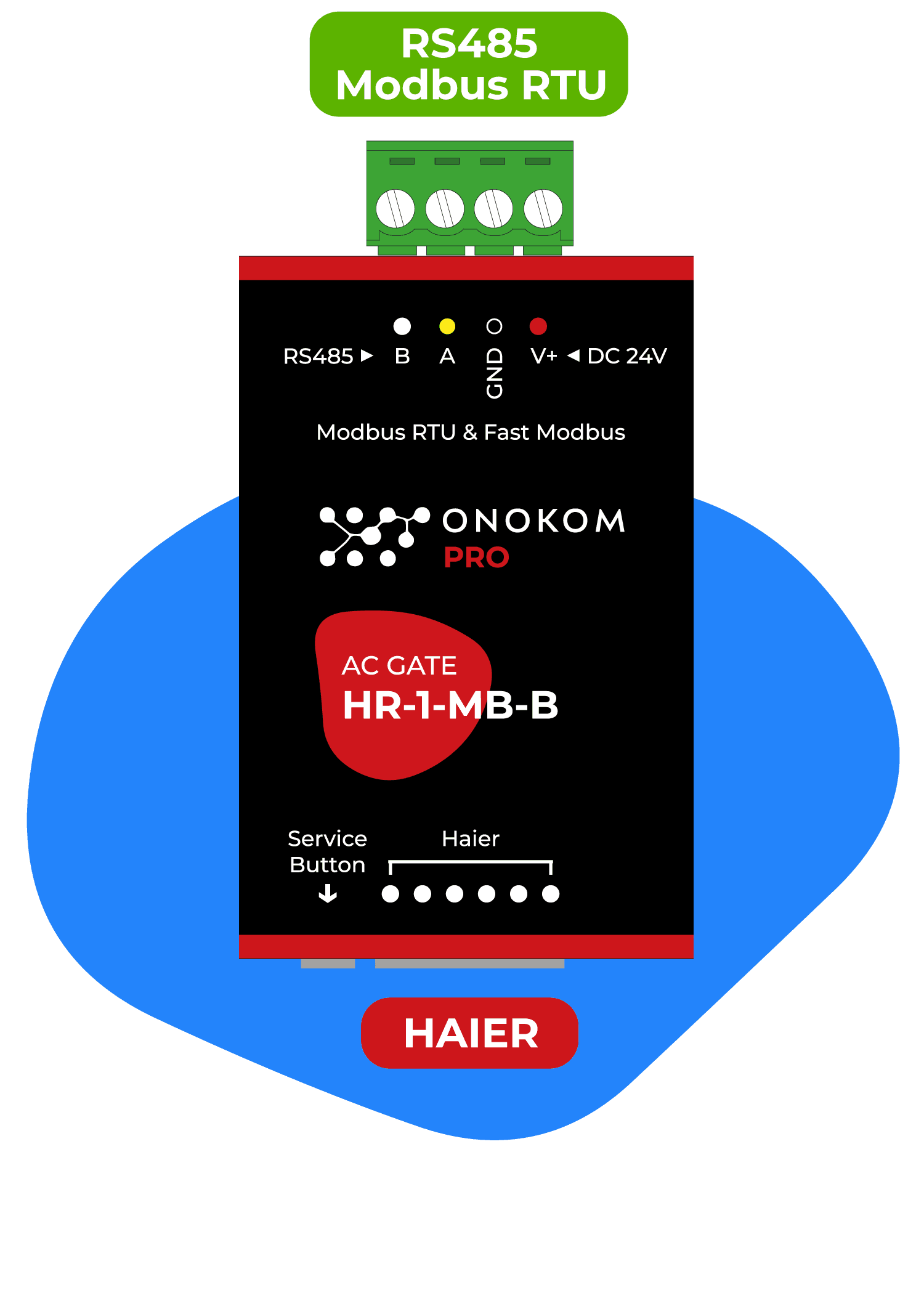
ONOKOM AIR HR-1-MB-B
Controls Haier air conditioners via the ONOKOM HR-1-MB-B Modbus gateway.
This template connects Haier air conditioners via the ONOKOM HR-1-MB-B Modbus RTU gateway to the ModbusCloud platform. It provides indoor and outdoor temperature readings, AC status monitoring, and full control of operating modes, fan speed, vanes, and target temperature.
- Protocol
- Modbus RTU
- Connection
- RS485, 9600 baud
- Registers
- 17, read and write
- Brand
- Onokom
- Key readings
- Indoor air temperature · Outdoor air temperature · AC connected · Screen light status · Sleep mode status · Turbo mode status
- Available commands
- Target temperature · Active on/off · Mode selection · Smart fan speed
- Compatible models
- ONOKOM HR-1-MB-B
- Last updated
Registers (17)
11 read, 14 write
| Name | Unit | Access | Address (Hidden until you enter your email) | Function (hidden) | Type (hidden) |
|---|---|---|---|---|---|
| Indoor air temperature | °C | Read | |||
| Outdoor air temperature | °C | Read | |||
| AC connected | Read | ||||
| Screen light (Status) | Read and write | ||||
| Beeper (Status) | Read and write | ||||
| Ionization (Status) | Read and write | ||||
| Self cleaning (Status) | Read and write | ||||
| Sleep mode (Status) | Read and write | ||||
| Vertical vanes (Status) | Read and write | ||||
| Turbo mode (Status) | Read and write | ||||
| Horizontal vanes (Status) | Read and write | ||||
| Active (Control) | Write | ||||
| Loxone modes (Control) | Write | ||||
| Smart fan speed | Write | ||||
| Target temperature | °C | Write | |||
| Vanes swing | Write | ||||
| Modbus address | Write |
Loading registers…
Send your device list
If a device is not in the library yet, we build the template for free as soon as we have the register data.
Use cases
- Monitor indoor and outdoor air temperatures on a live dashboard for each Haier AC unit.
- Control target temperature and operating mode remotely from the ModbusCloud platform.
- Create an alert when the AC unit loses connection or reports an unexpected status change.
- Schedule on/off switching and mode changes based on time of day or occupancy patterns.
- Track turbo mode and sleep mode usage to optimize energy consumption across multiple zones.
Installation
Wire the ONOKOM HR-1-MB-B gateway to the Haier indoor unit following the ONOKOM wiring guide, connecting the A and B terminals for Modbus RTU.
Connect the RS-485 bus from the ONOKOM gateway to the ModbusCloud Gateway, observing correct A, B, and GND polarity.
Set the Modbus slave address on the ONOKOM HR-1-MB-B and confirm the baud rate is 9600 with appropriate parity settings.
Import the ONOKOM AIR HR-1-MB-B template in the ModbusCloud platform and assign the matching slave address.
Verify communication by checking that indoor temperature and AC status readings appear on the ModbusCloud dashboard.
Review registers that share addresses (e.g., address 9 and 10) against the ONOKOM documentation to confirm correct function mapping for your installation.
Things to watch for
Why do some registers seem to return unexpected values?
The ONOKOM HR-1-MB-B uses shared register addresses for different functions. For example, address 9 serves both ionization and horizontal vane control. Consult the ONOKOM gateway documentation to determine which function is active in your configuration.
What baud rate and parity settings should I use?
The default baud rate is 9600. Check the ONOKOM documentation for the correct parity setting (commonly 8N1) and ensure the ModbusCloud gateway RS-485 port matches these settings exactly.
Can I control multiple Haier AC units from one Modbus bus?
Yes, each ONOKOM HR-1-MB-B gateway must be assigned a unique Modbus slave address. You can then add multiple instances of this template in ModbusCloud, one per unit, each with the corresponding address.
The AC unit shows as disconnected in the dashboard. What should I check?
Verify the RS-485 wiring between the ONOKOM gateway and the ModbusCloud gateway. Confirm that the slave address in the template matches the address configured on the ONOKOM device. Also check that the ONOKOM gateway is properly connected to the Haier indoor unit.
Want to see how it works?
