









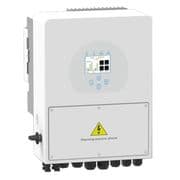
Sunsynk 3p hybrid inverter (grid)
The Sunsynk 3p hybrid inverter is a three-phase hybrid inverter for residential and commercial solar-plus-storage installations, managing power flows between PV, battery, grid, and loads. This Modbus RTU template reads the grid-side view of the inverter: total grid power (address 625), cumulative grid energy (address 522), and individual phase currents for phases A, B, and C (addresses 613, 614, 615). With these registers in your ModbusCloud portal you can track import and export in real time, verify balanced phase loading, and generate energy reports without additional metering hardware.
- Protocol
- Modbus RTU
- Connection
- RS485
- Registers
- 5, read only
- Brand
- Sunsynk
- Compatible models
- 3p hybrid inverter
- Last updated
Registers (5)
5 read, 0 write
| Name | Unit | Access | Address (Hidden until you enter your email) | Function (hidden) | Type (hidden) |
|---|---|---|---|---|---|
| power | W | Read | |||
| energy | Wh | Read | |||
| currents_a | A | Read | |||
| currents_b | A | Read | |||
| currents_c | A | Read |
Loading registers…
Send your device list
If a device is not in the library yet, we build the template for free as soon as we have the register data.
Use cases
- Monitor total grid power in real time to detect unexpected import peaks during low-solar periods.
- Track cumulative grid energy over time to verify net-metering settlement figures against utility invoices.
- Alert on phase current imbalance across phases A, B, and C to catch asymmetric load problems early.
- Compare per-phase currents over multiple sites to verify consistent installation quality across projects.
- Report daily grid import and export totals from the energy register to building owners or asset managers.
Installation
Enable Modbus RTU on the Sunsynk 3p hybrid inverter by navigating to Advanced Settings and then Multi-Inverter on the inverter display; note the configured Modbus SN (unit ID, typically 1).
Connect the RS-485 A and B terminals on the inverter to the ModbusCloud Gateway using a twisted-pair cable; keep the cable run to the minimum practical length and avoid sharing the pair with high-voltage wiring.
In the ModbusCloud portal, add the Gateway, create a new device, import the Sunsynk 3p hybrid inverter (grid) template, and set the unit ID to match the Modbus SN configured on the inverter.
Verify the connection by spot-checking the power register (address 625): under a known load or during active solar production the value should be a non-zero signed integer consistent with measured grid flow.
Things to watch for
All registers read zero or return timeout errors. What is wrong?
Confirm the RS-485 A and B wires are not swapped. The idle voltage between A and B on the Sunsynk RS-485 port should be around 4 to 5 V with nothing connected. A reading near 0 V or constant timeout usually indicates reversed polarity or a missing common ground between the Gateway and inverter.
Phase current registers read garbage or implausibly large values. Why?
The Sunsynk 3p hybrid inverter stores phase currents as signed int16 with a scaling factor of 0.1 A per unit. If your polling stack is treating the raw register value as unsigned, negative currents will appear as large positive numbers. Confirm your Modbus client interprets these registers as signed 16-bit integers.
The Gateway connects but the energy register shows no change. What now?
Address 522 is a uint32 spanning two consecutive 16-bit Modbus registers. Verify your client reads two registers starting at address 522 and combines them in big-endian word order, which is the standard Sunsynk byte order. Reading only a single register at that address will return an incomplete and static-looking value.
RS-485 communication is unstable with random CRC errors. What should I check?
If your RS-485 adapter includes a 120-ohm termination resistor, try removing it. The Sunsynk RS-485 port is typically the only device on the segment and adding a termination resistor at both ends of a short cable can over-terminate the bus, causing signal reflections and intermittent CRC failures.
Want to see how it works?
