



All topics
On this page
Every Modbus device you add gets a name, an address and registers in the portal. The portal sends them to the gateway, and the gateway then reads the Modbus device. The registers come from a template, or you enter them yourself.
What you need
- A gateway that is linked to your organisation, as described in Add a gateway. For automatic search it must be online.
- The role Owner, Admin or Technician. Other roles do not see the Add Modbus device button.
- Modbus devices that are connected as described in Connect the RS485 bus or Connect to the network via WAN and LAN.
Choose a way to add
The Add Modbus device window starts with one tile per method. The table shows what each tile does and when to choose it.
| Tile | What happens | Choose this tile if |
|---|---|---|
| Automatic search | The gateway searches its RS485 bus and its network for Modbus devices and suggests templates for each one it finds | you do not know what is connected, or you do not know the addresses and bus settings |
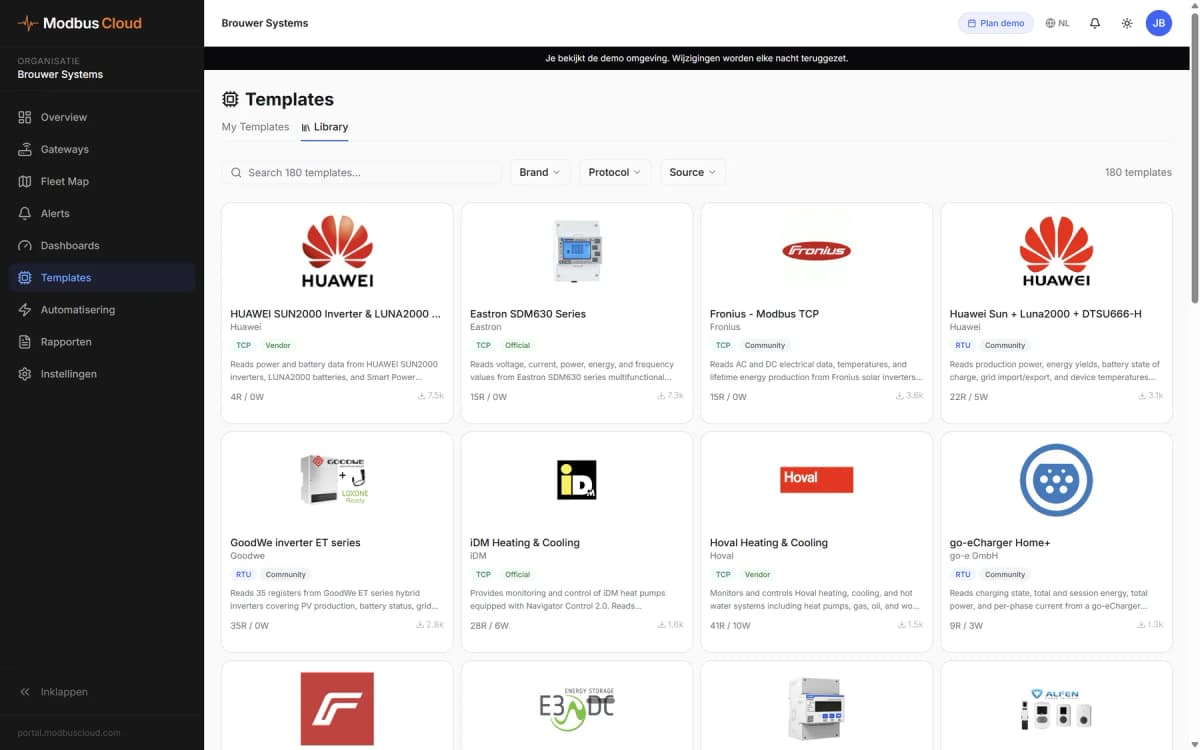
| Library | You choose a template by brand, model or category, then check the name, protocol and address that the portal fills in | you know the brand, type and address, or the Automatic search tile is missing |
| Custom template | The window closes and the Templates page opens with Create template | the Modbus device is not in the library and you connect this type more than once |
The Automatic search tile only appears if the gateway reports that it can search. A gateway with older software does not report this, and the tile is also missing in the demo account.
If a Modbus device is not in the library, ModbusCloud creates the template free of charge as soon as the register data is available. What to do until then is described in Modbus device is not in the library.
Add a Modbus device
Up to and including the choice of tile, the steps are the same for every method.
Open the gateway list
Open Gateways in the menu.
Open the gateway
Click the gateway that the Modbus devices are connected to. The gateway page opens on the Overview tab.
Start adding
At the top right of the Modbus devices, click Add Modbus device. The window with the tiles opens.
Choose a tile
Choose Automatic search, Library or Custom template.
Finish the route
Follow the steps for your tile in Find Modbus devices with automatic search, Choose a template from the library or Create a custom template. The Modbus device is on the gateway as soon as you click Add.
After you create a custom template, you choose it through Library. It is at the top, under Your templates.
Wait for the first values
After Add, the portal saves the Modbus device, sends the configuration to the gateway and shows Modbus device added. If sending fails, the portal tells you that as well. The configuration then goes along with the next change you save to a Modbus device on this gateway. More about this is in Message when adding or saving a Modbus device.
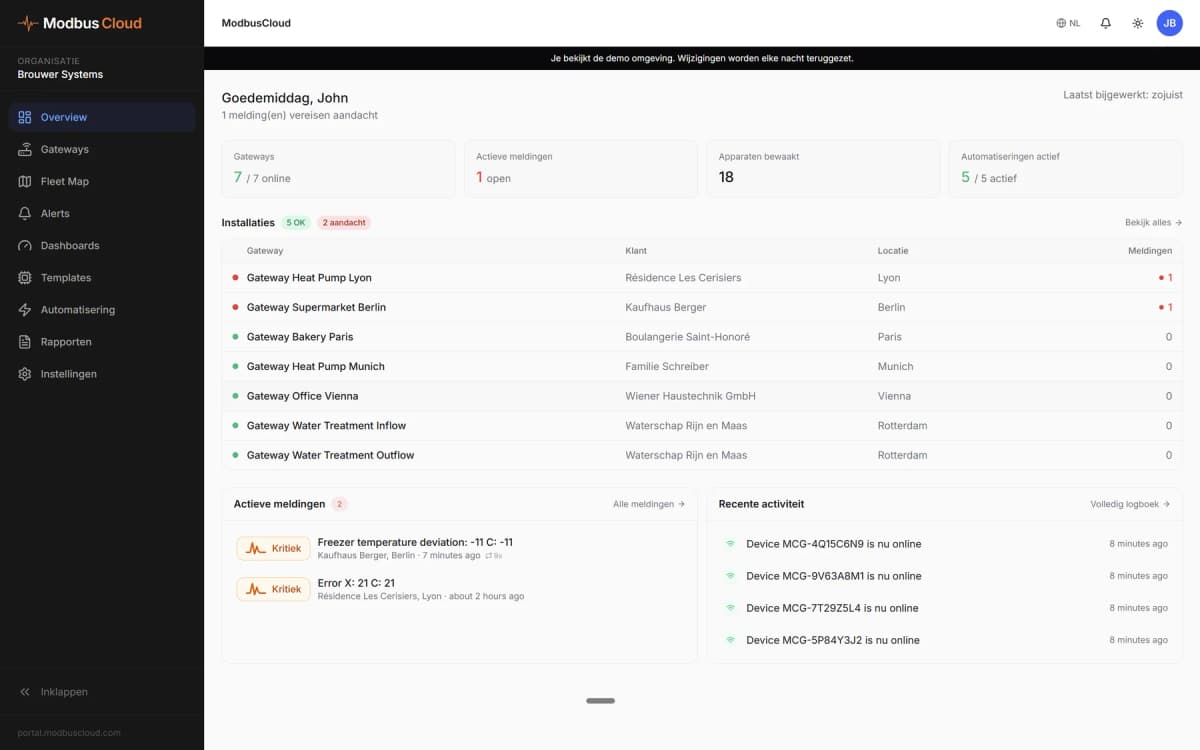
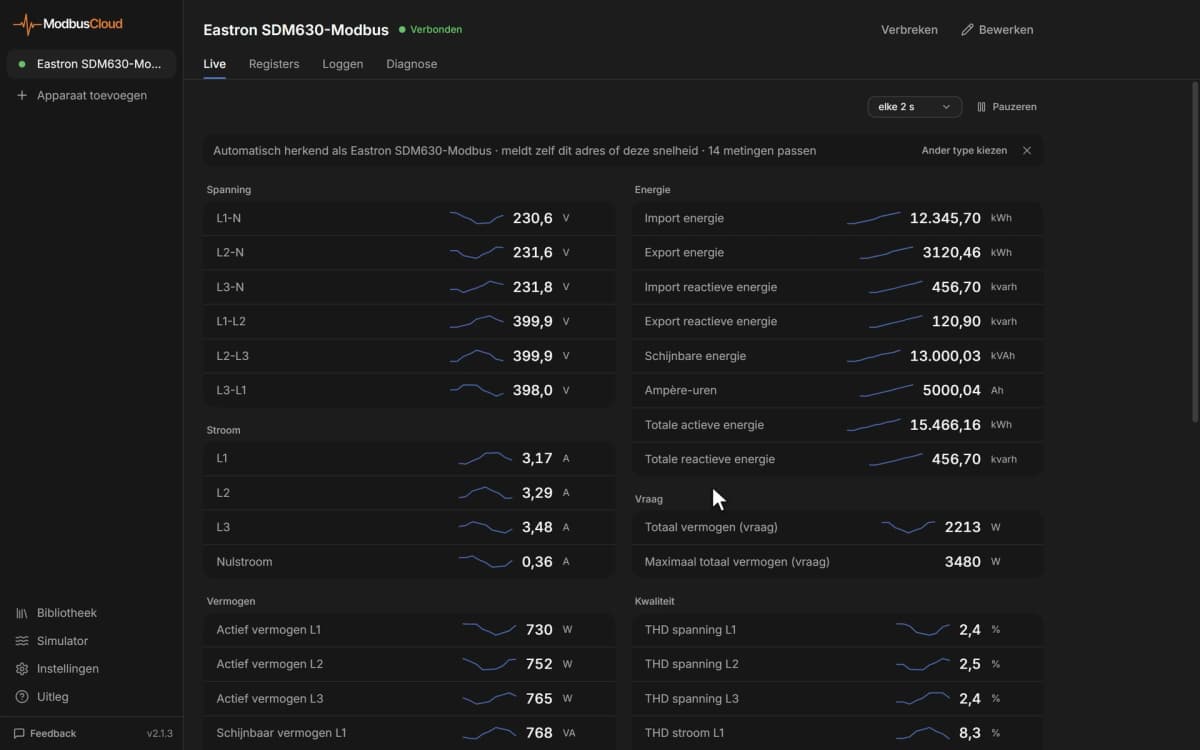
The Modbus device now appears as a card on the Overview tab, with the status Unknown until the first reading arrives. After that, the card shows the values per register and the status changes to Responding.
By default, the gateway reads a new Modbus device every 300 seconds (5 minutes). If the gateway is on 4G, it does not read more often than the SIM interval. How to change both is described in Choose the polling interval. If there are still no values after one polling interval, follow Modbus device shows no values.
If the gateway already has default alerts, the portal also creates alert rules for the registers of the kind Fault code on the new Modbus device. How this monitoring works is described in Automatic monitoring. You check whether the values are correct as described in Check and hand over the installation.
Bus settings apply to the whole RS485 bus
Baud rate, parity, stop bits and data bits are set per gateway, by default 9600 8N1. They apply to every Modbus RTU device on the RS485 bus, and each of those Modbus devices must be set to the same values itself.
In the Configure Modbus device window, they appear under Seriële bus (serial bus) for information only. You change them in Gateway settings under Modbus RTU-bus (Modbus RTU bus), as Gateway settings describes.
If automatic search finds a Modbus RTU device with different bus settings, the portal sets the gateway bus to those settings when you click Add. If other Modbus RTU devices are already on the gateway, the bus stays as it is and the portal does not add the Modbus device.
You do set the slave address per Modbus device, as Set the address and connection of a Modbus device describes.
Updated on 7 October 2026
Still stuck?
Email or call us. Include the serial number of the gateway, so we can take a look straight away.
Go to support