



All topics
On this page
The file comes from the history of the gateway. The history keeps at most one reading per register per minute, even if the gateway reads every second. Anyone who can open the gateway can download, including a team member with read-only access.
Download the file
Loading the walkthrough.
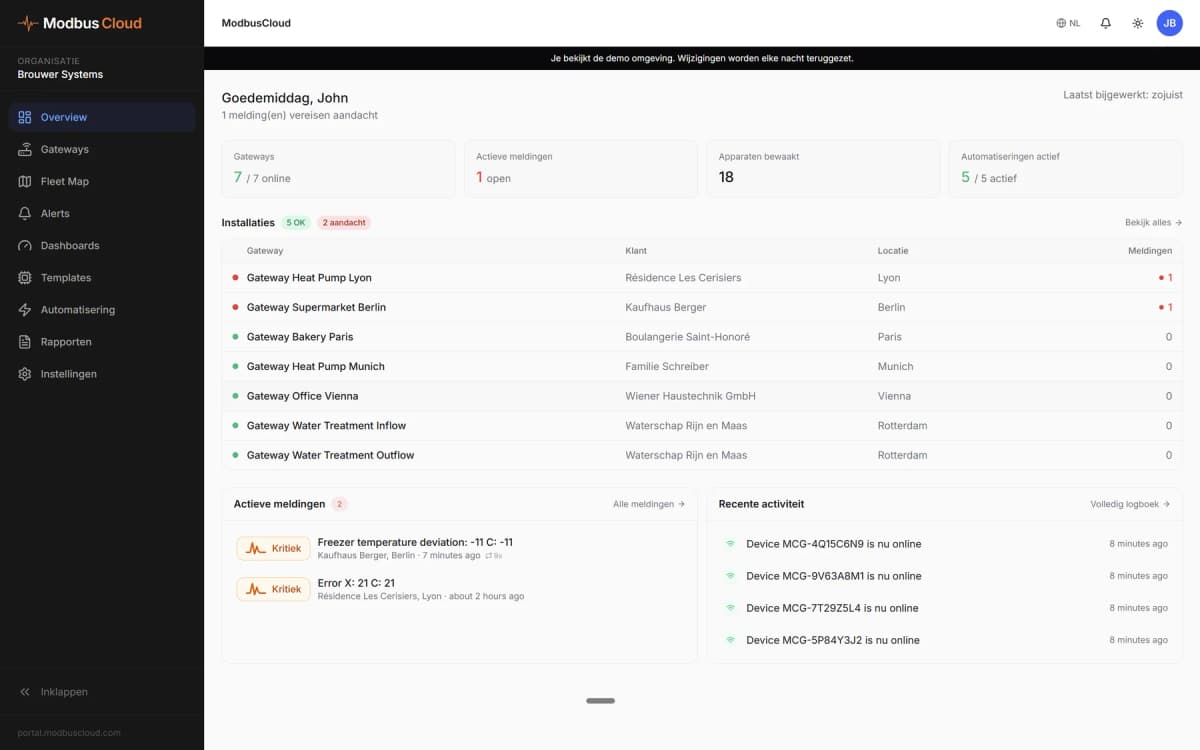
Open the gateway list
Open Gateways in the menu.
Open the gateway
Click the gateway whose readings you want.
Open the menu
Open the menu with the three dots at the top right of the gateway page.
Open the download window
Choose Download readings. The Download readings window opens.
Choose the period
In Period, choose how far back you want to go. The choices are Last 7 days, Last 30 days, Last 12 months and Everything. The default is Last 30 days.
Save the file
Click Download. When the file is ready, the browser saves it and the window closes.
On a phone or in a narrow browser window, the gateway page has no menu with three dots. The download icon (Download readings) in the bar at the top opens the same window there.
Everything includes all stored readings. How long readings are kept is described in Retention periods and exporting your data.
What the file contains
The file name starts with the name of the gateway, or with the serial number if the gateway has no name of its own. The first column gives the date and time as YYYY-MM-DD HH:MM:SS, in Dutch time. This also applies if your profile or organisation is set to another time zone.
After that, each register gets its own column, in order of register address. The header is the name of the register with the unit, for example Voltage L1 (V). The name of the Modbus device is not part of it.
If two Modbus devices of the same type are connected to the gateway, their columns get the same headers. To tell them apart, give the registers of one of them another name, as described in Set up registers.
Values are included with the scale already applied, as in the portal. A register that reads 2314 with scale 0.1 appears as 231.4. The file uses the scale that is currently set on the register, also for older readings. A status register appears as a number, not as the text the portal shows next to it.
Registers that were read at the same moment share a row. An empty cell means the register has no reading at that time. Values from the Variables tab are not in the file.
Format for Excel
The format follows the language in which you use the portal. The table shows how the file is formatted for each language.
| Portal language | Separator | Decimal mark | Header of the time column |
|---|---|---|---|
| Nederlands | ; | , | Tijdstip |
| Deutsch | ; | , | Zeitpunkt |
| English | , | . | Time |
Excel recognises the file as UTF-8, so characters such as °C and ü display correctly.
Too many readings for one file
A file holds at most 500 000 readings. A reading is one value of one register. With 20 registers and a polling interval of 300 seconds, you reach that limit after about 87 days. With an interval of 60 seconds or shorter, it is after about 17 days.
If the period holds more, you get the newest readings. The browser still saves the file. The window stays open with the message Too many readings for one file: it holds the latest 500,000. Choose a shorter period for everything.
The first line of such a file states the time from which it is complete. The headers are then on the second line. To get a period in full, choose a shorter period. If even Last 7 days does not fit, or if you want the readings from before that time, use the REST API.
Get readings in another way
The table compares the three ways.
| What | Download readings | CSV on Trends | REST API |
|---|---|---|---|
| Registers | All registers of the gateway | The registers in the chart | All registers or a selection |
| Period | Last 7 days, Last 30 days, Last 12 months or Everything | 1h, 6h, 24h, 7d or 30d | Start and end of your choice, at most 7 days per request (366 days for a single register) |
| Detail | Every stored reading | Individual readings at 1h and 6h, averages after that | Every stored reading |
| Format | CSV for Excel in the language of the portal | CSV with commas and a decimal point | Pages of at most 1000 readings |
How the CSV button works is described in View values and charts. For the API you need an API key, as described in REST API and webhooks.
Updated on 7 October 2026
Still stuck?
Email or call us. Include the serial number of the gateway, so we can take a look straight away.
Go to support