


All topics
On this page
On the gateway page, a Modbus device under Modbus devices now and then shows Timeout, with No data since and a time. Later it shows Responding again. First check whether this affects all Modbus devices on the bus or only one. A fault in the bus usually hits several Modbus devices, while a deviating bus setting hits only that one.
The status Timeout appears only after 5 times the polling interval without a reading, and never within 15 minutes. During a shorter dropout, only the time at the bottom of the card runs on. If automatic monitoring is on, the alert Modbus device not reporting opens and later gets the status Returned.
If a Modbus device never delivers values, see Modbus device shows no values. If the gateway sends over the SIM, it reads no more often than the SIM interval. That is covered in Values arrive less often than set.
The table links what you see to the likely cause.
| What you see | Likely cause |
|---|---|
| All Modbus devices drop out now and then | No signal ground, wrong termination, a second master or stubs |
| Mostly Modbus devices far from the gateway drop out | Termination resistor at the end is missing |
| One Modbus device drops out now and then | Baud rate, parity or stop bits differ |
| It goes wrong as soon as a pump or compressor starts | Bus cable next to power cables, or shield earthed at both ends |
Modbus devices drop out now and then
The gateway gets no answer or a damaged answer to part of its requests, and discards the damaged ones. How the bus should run is described in Connect the RS485 bus.
The signal ground is missing
RS485 needs a third wire next to the wire pair, the signal ground. Without it, the voltage floats between the gateway and the Modbus devices. In practice, 30 to 50% of the answers then arrived damaged.
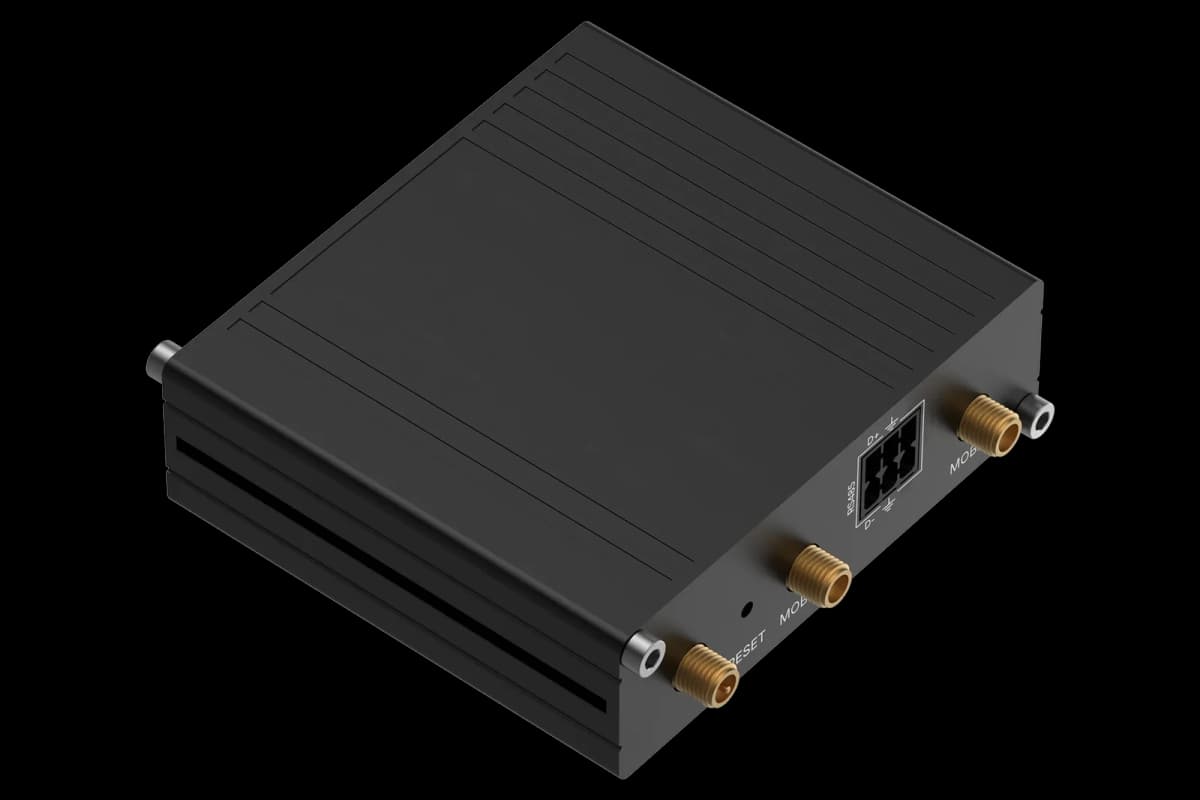
Check whether a wire is connected to a ⏚ contact on the gateway. It continues to the ground terminal of every Modbus device, often marked GND, COM or 0. If it is missing, run a third wire along all Modbus devices. The shield does not count as signal ground.
The termination resistors are not at the two ends
An RS485 bus has 120 Ω between the data wires at both ends, usually at the gateway and at the last Modbus device. There should be none in between. Many Modbus devices have a built-in termination resistor with a switch or jumper. Turn it on only at the last one.
Switch off the gateway and all Modbus devices, then measure the resistance between D+ and D- on the gateway terminals. Around 60 Ω is correct, around 120 Ω means one is missing, and around 40 Ω or lower means there are three or more. Fit a termination resistor at each end and remove the rest.
A second master reads the same bus
The gateway is the master on its RS485 bus. If a building management system, a PLC or an inverter with its own kWh meter reads the same bus, the messages of two masters collide.
Follow the bus cable and check whether such a system is connected. Remove one of the two masters. If both must read the Modbus device, use Modbus TCP when the Modbus device has a network connection and allows more than one connection.
Baud rate, parity or stop bits differ from the gateway
All Modbus devices on the bus use the same baud rate, parity, stop bits and data bits as the gateway. The setting of the gateway is in Gateway settings under Modbus RTU-bus (Modbus RTU bus), written in short form such as 9600 8N1.
Compare it with the display or menu of every Modbus device, including those that were already installed. The factory parity often differs. Set a deviating Modbus device to the setting of the gateway. If the whole bus needs a different setting, change the gateway as described in Gateway settings.
The bus runs as a star or with long stubs
RS485 runs as one line from Modbus device to Modbus device, because every stub reflects part of the signal. A short loop-through on the terminals is fine, but a stub longer than 1 m is not. Rebuild the bus as a single line. If the building does not allow that, fit an RS485 repeater.
It goes wrong as soon as a machine starts
If the bus drops out as soon as a pump, compressor or frequency drive starts, interference is coupling into the bus cable. Note the times of the dropouts and ask what switches on then.
The bus cable runs next to power cables
Frequency drives and switching power supplies couple interference into a bus cable in the same trunking. Keep the bus cable at least 100 mm from power cables, do not bundle them and cross them at 90°.
The shield is earthed at both ends
A shield that is earthed at both ends creates an earth loop that puts interference on the bus. Check where the shield is earthed. Loop it through at every Modbus device and earth it at one point, preferably at the gateway.
A value jumps between good and nonsense
A garbled answer does not become a value in the portal. The gateway discards an answer with a CRC error, so a poor connection on the bus gives gaps between the readings and not wrong values.
If a value still jumps now and then to nonsense or to 0, compare it at that moment with the display of the Modbus device. If the display jumps too, the Modbus device measures that value itself. If a value is always wrong, see Values are wrong.
Measure the answers with Diagnostics
The portal does not count missed or garbled answers. Measure the bus on site with ModbusCloud Diagnostics and a USB-RS485 adapter. Diagnostics is a master itself, so the gateway is off the bus for the duration.
Take the gateway off the bus
Disconnect the wires from D+, D- and ⏚ on the gateway. If a termination resistor was fitted there, take it to the adapter.
Connect the adapter
Connect the wires to the USB-RS485 adapter, with the signal ground on GND.
Connect the Modbus device
Connect Diagnostics to the Modbus device that is furthest away, with the bus setting of the gateway. See Connect and find a Modbus device with Diagnostics.
Let it read
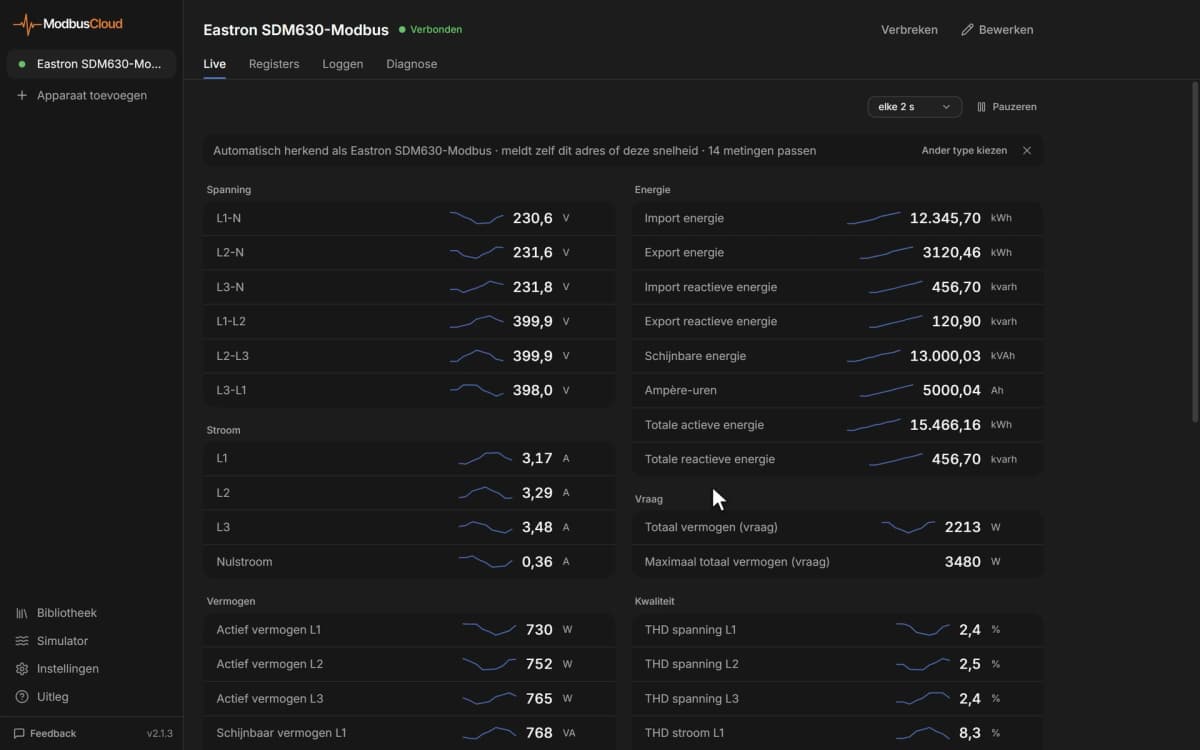
Open the Live tab and let it read for a few minutes.
Check the result
Open the Diagnostics tab. At the top it shows which part of the requests got an answer. Under Recent errors it shows how often an error such as Garbled answers occurred in the last 5 minutes.
Put the gateway back
Connect the wires to the gateway again.
If 95% or more of the requests get an answer, the verdict is Healthy. Change one thing at a time and then measure again. How to read the console is described in Find faults with the Diagnostics tab and the console.
Contact support
If this does not solve it, contact us through the support page. Send the serial number of the gateway and say which Modbus devices drop out and since when. Add photos of the RS485 connections at the gateway and at the last Modbus device. If you measured with Diagnostics, paste the text of the report as well.
Updated on 7 October 2026
Still stuck?
Email or call us. Include the serial number of the gateway, so we can take a look straight away.
Go to support