



All topics
On this page
The identification runs on the gateway itself. The gateway reads registers from every Modbus device that answers and compares the values with the template library stored on it. The Modbus requests travel over the RS485 bus and the local network, so searching also works when the gateway is connected over 4G. The search only reads and never changes an address or bus setting on a Modbus device.
What you need
- The role Owner, Admin or Technician in your organisation.
- A gateway with the status Online that reports it can search.
- Modbus devices that are switched on and connected as described in Connect the RS485 bus or Connect to the network via WAN and LAN.
Where the gateway searches
The table shows what the gateway tries on the bus and in the network.
| Where | Search | Search everything |
|---|---|---|
| RS485 bus (Modbus RTU) | Common combinations of baud rate, parity and stop bits until one answers, with the common addresses | All common combinations with the common addresses, then every address 1-247 on each combination that answered |
| Network (Modbus TCP) | Port 502, with the common unit IDs | Port 502, with unit ID 0, 1-247 and 255 |
For Modbus TCP, the gateway searches the network on its LAN port. If its internet runs through the cable on the WAN port, it also searches that network when it uses private addresses. Over 4G, it searches only on the LAN port.
The gateway searches each network only within the /24 around its own address. A Modbus TCP device on another port or in another network you add yourself, as described in Set the address and connection of a Modbus device.
Start the search
Loading the walkthrough.
Open the gateway list
Open Gateways in the menu.
Open the gateway
Click the gateway the Modbus devices are connected to. The gateway page opens on the Overview tab.
Start adding
Click Add Modbus device, at the top right above the Modbus devices.
Choose automatic search
Choose Automatic search. If that tile is missing, follow Automatic search does not find everything.
Enter the numbers
In What did you connect?, click the plus next to each kind of Modbus device, once per device. If no kind fits, click the plus next to Other.
Start the search
Click Search. The window shows This usually takes 1 to 2 minutes.
Search everything
Searching everything tries more addresses and unit IDs than searching with numbers, so it takes longer. To do this, click I don't know yet, just search everything in What did you connect?. If you leave all numbers at 0 and click Search, the gateway also searches everything.
During the search
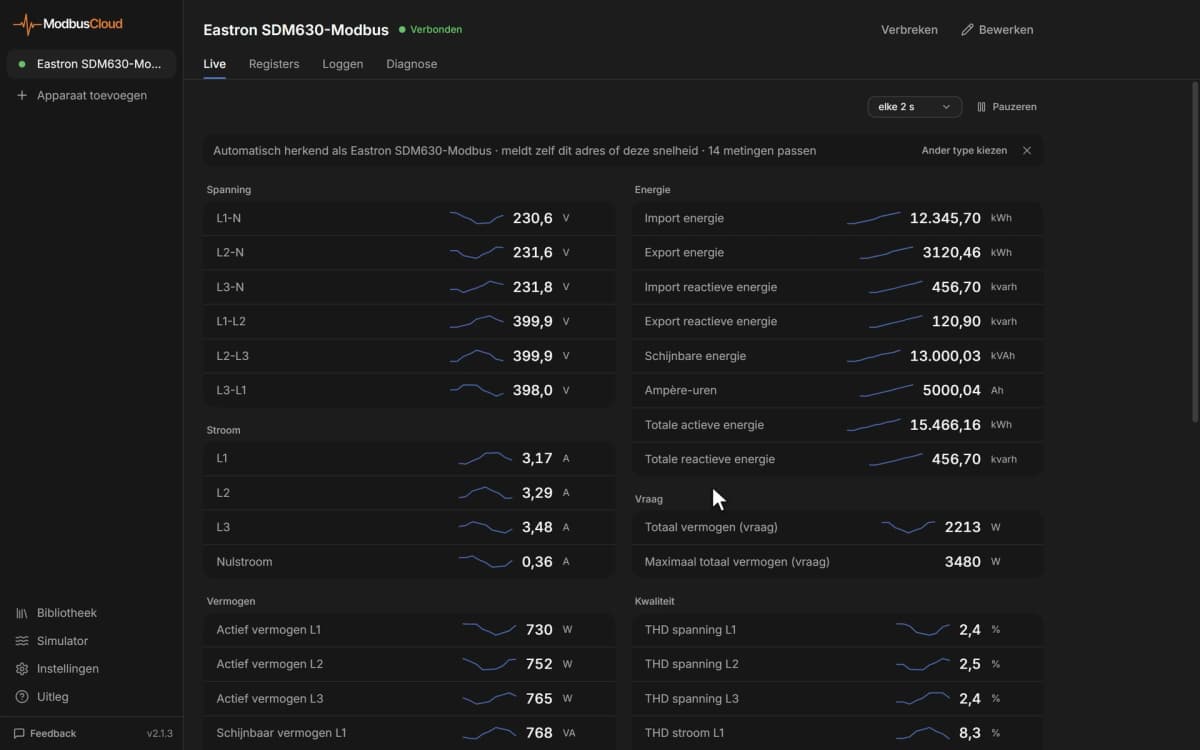
The gateway searches the RS485 bus first and then the network. When it recognises a Modbus device, the device appears in the window with the most likely type and the first values.
The search on the bus and the search in the network each take 10 minutes at most. If a part is not finished by then, the window shows what the gateway found so far. While your own search is running, you can close the window only by stopping the search.
If a search is already running on the gateway, for example one started by a colleague, the window shows A search is already running on this gateway. Click View to watch along. With Hide you close that window while the search continues.
Stop the search
You can stop as long as the search is running. The window then closes without the Modbus devices the gateway already found.
Request the stop
Click the cross next to the title Automatic search (Cancel search). The window asks Stop searching?
Confirm the stop
Click Stop searching. The window closes and the portal reports Search stopped. The gateway then reads the Modbus devices again.
Add the Modbus devices that were found
After the search, each Modbus device that was found has its own block, with the address or IP address above it. The options in the block are numbered, with the most likely first. Below the chosen option are the registers with the values the gateway read.
Choose an option
Click the option that matches the Modbus device. The first option is already chosen.
Check the values
Check that the values below the option are plausible, such as a voltage around 230 V. If they are not, choose another option.
Add the Modbus device
Click Add. The portal reports how many registers the Modbus device received and sends the settings to the gateway.
Handle the other blocks
Handle every other block with Add, Other Modbus device or Not on this bus.
Close the window
Click Go to overview. This button appears when every block is handled and at least one Modbus device has been added. The new Modbus devices appear on the Overview tab.
Add in a block sets the polling interval to 300 seconds (5 minutes). You choose a different interval as described in Choose the polling interval.
For a Modbus RTU device, the gateway adopts the bus settings on which the device answered, if no other Modbus RTU device is connected yet. If Modbus RTU devices on other settings are already connected, the block reports that and the portal adds nothing. The bus settings of the gateway are described in Gateway settings.
If no option is correct, click Other Modbus device. Choose brand and model yourself at the bottom of the list does the same. You then choose the template yourself, as described in Choose a template from the library, with the address and connection from the search already filled in. After Add, the window returns to the Modbus devices that were found.
If the type is not in the library, follow Modbus device is not in the library.
If a Modbus device that was found does not belong to this installation, or is already in the portal, click Not on this bus. If you reject every block without adding anything, the window returns to the tiles.
If the search found nothing, the window reports No Modbus devices found. Click Search again or Choose brand and model yourself. Why the search misses a Modbus device or cannot add it is explained in Automatic search does not find everything.
Updated on 7 October 2026
Still stuck?
Email or call us. Include the serial number of the gateway, so we can take a look straight away.
Go to support